What Makes RF Circulators Essential for 5G Networks?
Deep technical guide on why RF circulators are essential in 5G: PA protection, shared-antenna TX/RX, Massive MIMO integrity, Sub‑6 & FR2 readiness, qualification, and a practical selection checklist.
 Updated on: Dec 24, 2025
 Author:
1. Introduction
5G is not one network but a stack of modalities — Sub‑6 GHz (FR1) for wide coverage, mmWave (FR2) for extreme capacity, and a spectrum of antenna topologies from macro RRUs to compact tiles and rooftop small cells. What unifies these deployments is the need to control reflections and inter‑chain leakage without paying too much in insertion loss (IL). Circulators provide uniquely non‑reciprocal routing that suppresses reverse‑traveling energy and keeps PA operating points stable under weather, vibration, and user dynamics.
From a system architect’s perspective, the circulator acts like a one‑way rotary junction: Port 1 → Port 2 → Port 3 → Port 1. A common use case is to terminate Port 3 with a 50‑ohm load so that any reflected power from the antenna is safely absorbed, protecting the PA. Engineers often pair the circulator with directional couplers, limiters, and power detectors to implement protection loops and field diagnostics.
2. What a Circulator Does
A circulator routes energy Port‑1→2, 2→3, and 3→1. In a 5G radio, the amplifier’s output at Port‑1 travels through Port‑2 to the antenna; any reflected energy returns to Port‑3, where it is absorbed by a matched load or directed into a receiver path. This directionality is the essential difference from a switch or splitter — a circulator enforces asymmetric paths for forward and reverse waves, which simplifies duplexing and protects semiconductors.
3. Why 5G Needs It More Than LTE
Compared with LTE, 5G widens channel bandwidths (e.g., 100 MHz in FR1, hundreds of MHz in FR2), increases crest factors, and multiplies the number of active RF chains per sector. Mismatch, cable motion, ice and rain loading, and fast traffic scheduling can modulate VSWR in milliseconds. A low‑loss/high‑isolation circulator damps these disturbances so beamforming codebooks remain valid, on‑air recalibration is less frequent, and PA alarms are rarer — all of which improves spectral efficiency and OPEX.
4. Specs That Move System KPIs
Insertion Loss (IL). Every tenth of a dB matters. Sub‑6 macros typically target ≤0.3–0.5 dB depending on band; FR2 arrays budget similar absolute loss because propagation loss is already high. Isolation (ISO). Treat 20–25 dB as a practical floor for Massive MIMO; denser arrays and tighter ACLR/EVM masks justify higher ISO. Return Loss / VSWR. Predictable port match reduces ripple and protects linearity under high‑PAPR waveforms. Linearity & Power Handling. Devices must remain linear across crest‑factor peaks without thermal runaway. Temperature Stability & Aging. Ferrite and bias design should keep phase/amplitude drift within calibration budgets across seasons.
5. Sub‑6 vs. FR2 — Same Need, Different Constraints
FR1 macro RRUs operate outdoors with wind, vibration, lightning, and thermal cycling. Here, packaging stiffness and baseplate conduction dominate long‑term behavior. FR2 tiles are density‑limited: interconnect parasitics and stack‑up choices determine whether IL/ISO targets are met. SMT or microstrip drop‑ins are preferred to minimize line length and group‑delay ripple; dense via fences and continuous grounds keep inductance low so phase holds across channels.
6. Massive MIMO Integrity Depends on Isolation
A 64T64R radio runs dozens of simultaneous streams. Leakage between adjacent chains widens main lobes, fills nulls, and depresses MU‑MIMO capacity. High‑isolation circulators reduce inter‑chain coupling so digital precoding works as intended. The payoff is steadier EVM, more predictable codebooks, and lower frequency of on‑air calibration windows.
7. Topology & Materials — Why Ferrite Still Leads
Magnet‑less non‑reciprocity (spatiotemporal modulation, acoustic media, time‑varying networks) is progressing, but ferrite remains the proven choice for infrastructure. High‑Curie materials provide thermal headroom; YIG/YAG formulations deliver predictable dispersion; and robust magnets hold the bias point across diurnal and seasonal swings. Packaging maps to power and integration: SMT/drop‑in microstrip for arrays and RRUs, coaxial for flexible harnessing, and waveguide for high‑power feeders/backhaul.
8. Mechanical & Thermal Integration
Field reliability is won in the details. Keep heat‑spreading continuous to the frame; avoid airflow shadows near fans; minimize z‑height of thermal interfaces; and place the circulator close to the PA/LNA so temperature gradients are small. On PCBs, short symmetrical feeds and dense stitching vias maintain current returns and reduce peaking. These mundane choices visibly improve EVM and calibration hold time.
9. Qualification Beyond the Datasheet
Validate more than pretty S‑parameter plots at 25 °C. Sweep IL/ISO/return loss across band and temperature; test linearity under NR traffic rather than only CW; run thermal shock, humidity, salt fog, and vibration that mirror rooftop life. Record part‑to‑part phase/amplitude spread across lots — that spread becomes the array calibration budget. Suppliers with strong process control will share Cpk data and maintain traceability.
10. Selection Checklist for Base Stations & Small Cells
- Band / bandwidth: contiguous, segmented, or multi‑band aggregation.
- IL budget: protect both EIRP and sensitivity; 0.2 dB is material in FR2.
- ISO target: ≥20–25 dB typical; higher for tight masks or dense tiles.
- Power & crest‑factor margins: worst‑case ambient and cabinet rise.
- Form factor: SMT/drop‑in for tiles & RRUs; coax/waveguide for feeders/backhaul.
- Environment: IP rating, corrosion resistance, UV stability, lightning path.
- Lifecycle: OEM/ODM capability, obsolescence plan, parametric stability over years.
11. Cost of Not Using Circulators
Skipping or under‑specifying circulators raises PA stress, increases field recalibration, and lowers spectral efficiency. Across a fleet, extra truck rolls and emergency retunes dwarf the device delta cost. Conversely, low‑loss, high‑ISO parts with stable match pay back in uptime and throughput.
12. FR2 Special Notes (26–40+ GHz)
Packaging parasitics are unforgiving at mmWave. Favor footprints that minimize feed length and maintain continuous reference planes. Keep sub‑array reference phases tidy to prevent skew — even 1–2° per chain accumulates across 64+ elements. Avoid discontinuities and via stubs that inject group‑delay ripple.
13. Working with Filters & Duplexers
In shared‑antenna designs, circulators complement filters/duplexers rather than replace them. Selectivity (filter), isolation (duplexer), and non‑reciprocity (circulator) together deliver separation and PA protection without punitive loss.
14. Procurement & Quality
Request golden‑unit S‑parameter datasets, temperature sweeps, and drift characterization. Confirm RoHS/REACH compliance and serialization/traceability so field investigations can map units to lots. Prefer suppliers with change‑control and second‑source strategies for program risk reduction.
15. Field Lessons from 5G Rollouts
- Rooftop VSWR drifts seasonally due to water ingress/ice; isolation margin avoids PA alarms.
- HVAC vibration can modulate coax feeds; secure routing reduces time‑varying mismatch.
- Dense urban grids benefit from higher ISO to stabilize inter‑site interference for coordinated scheduling.
- Mountain/coastal sites see salt fog and rapid temperature swings — sealing and thermal paths matter.
16. Looking Toward 6G
Even if magnet‑less approaches reach production, ferrite circulators will remain essential where high power, harsh environments, and longevity dominate. Design today with drop‑in paths so tomorrow’s radios can adopt newer non‑reciprocal tech without a ground‑up RF re‑architecture. The fundamentals — low IL, strong ISO, controlled match, disciplined packaging — remain timeless levers for better EVM and lower TCO.
FAQ
How much isolation is “enough” for Massive MIMO?
Treat 20–25 dB as a starting point; denser arrays and tighter EVM targets justify higher values.
Do circulators still make sense at mmWave?
Yes — for power handling, thermal headroom, and long‑term stability; packaging is the main challenge.
Can a switch replace a circulator?
No. Switches route signals but are reciprocal; a circulator introduces directionality and safely sinks reflections.
References
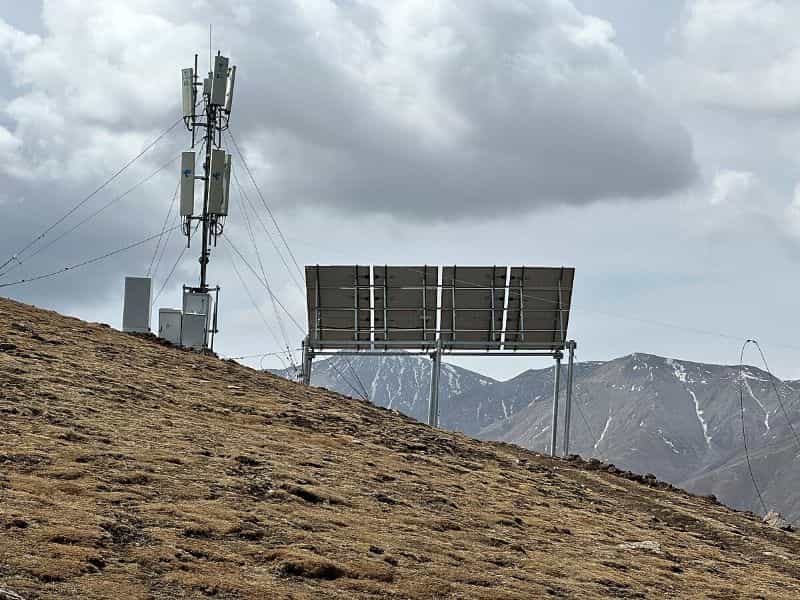
- Photo: Base Transceiver Station in the Laji Mountain Pass (5G) — © Michał Beim, CC BY 4.0, via Wikimedia Commons.
- Background on S‑parameters and VNAs: Wikipedia “Network analyzer (electrical)”.
- Open literature and vendor notes on Massive MIMO, PA protection, and Sub‑6/FR2 packaging.
 Article Tags
Keith Wong
Marketing Director, Chengdu Hertz Electronic Technology Co., Ltd. (Hzbeat)
Keith has over 18 years in the RF components industry, focusing on the intersection of technology, healthcare applications, and global market trends.