How to Select a Circulator by Frequency, Power, and Size
Learn how to select an RF circulator based on frequency range, power handling, size, insertion loss, isolation, VSWR, mounting method, and operating conditions.
 Updated on: Jul 30, 2026
 Author:
An RF circulator is a passive, non-reciprocal component that routes radio-frequency signals between three ports in a fixed direction. Circulators are widely used in wireless communication systems, power amplifiers, radar equipment, base stations, and microwave systems.
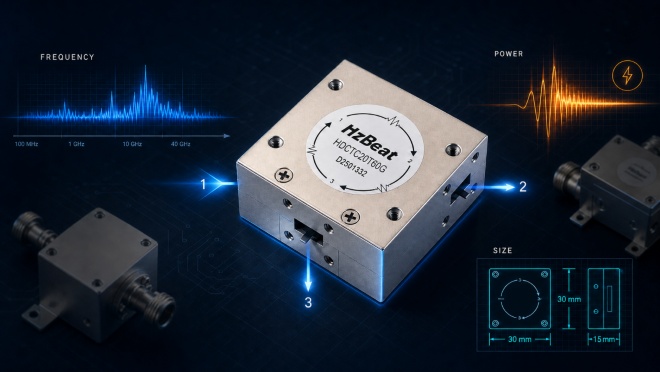
When selecting a circulator, frequency range, power handling, and physical size are the three primary considerations. However, insertion loss, isolation, VSWR, circulation direction, mounting method, and operating temperature should also be evaluated.
Frequently Asked Questions
1. What should I check first when selecting an RF circulator?
Start with the required operating frequency range. Identify the following system requirements:
- Center frequency
- Minimum and maximum frequencies
- Required bandwidth
- Frequency tolerance
- Expected frequency drift over temperature
The circulator’s entire rated frequency range must cover the system bandwidth. It is advisable to leave some margin for component tolerance, temperature variation, and production differences.
2. Why is the operating frequency range so important?
A circulator’s insertion loss, isolation, and VSWR vary with frequency. A component that performs well at its center frequency may not provide the same performance near the edges of its specified band.
Do not select a circulator based only on its center frequency. Check the guaranteed performance across the complete operating band.
3. How do I determine the required power rating?
Consider both forward power and reflected power. The relevant parameters may include:
- Continuous-wave power
- Average input power
- Peak or pulsed power
- Duty cycle
- Peak-to-average power ratio
- Reflected power caused by load mismatch
The circulator’s rated power should exceed the maximum power expected under actual operating conditions. Additional margin may be necessary for high temperatures, poor cooling, or severe antenna mismatch.
4. Is average power sufficient for selecting a circulator?
Not always. Average power may be sufficient for a continuous-wave application, but pulsed systems also require an evaluation of peak power, pulse width, and duty cycle.
A circulator may satisfy the average-power requirement while still being damaged by excessive peak voltage or peak RF power. The manufacturer’s test conditions should therefore be reviewed carefully.
5. Why should reflected power be considered?
When an antenna or load is mismatched, some transmitted energy is reflected toward the power amplifier. A circulator redirects this reflected energy to another port, helping protect the amplifier.
However, the circulator must still withstand the reflected power. Check its reflected-power rating, load VSWR conditions, termination capacity, and thermal requirements.
6. Is a smaller circulator always better?
No. A smaller circulator saves PCB space, but size is often associated with trade-offs in:
- Power-handling capability
- Operating bandwidth
- Insertion loss
- Isolation
- Heat dissipation
- Mounting complexity
Frequency and power requirements should be satisfied first. Physical size should then be used to choose among the technically suitable models.
7. Which dimensions should be checked?
Check the complete mechanical specification rather than only the nominal package size:
- Length and width
- Maximum component height
- Pad layout
- Port locations
- Required ground area
- Clearance around the component
- Connector or terminal dimensions
Also verify whether the circulator uses surface-mount, through-hole, drop-in, coaxial, or waveguide mounting.
8. What is insertion loss, and why does it matter?
Insertion loss is the signal loss in the intended transmission direction. A lower value is generally preferred.
Excessive insertion loss reduces the power delivered to the load and increases heat inside the circulator. In high-power systems, even a relatively small additional loss can have a meaningful effect on efficiency and temperature.
9. What is isolation?
Isolation describes how effectively the circulator prevents a signal from traveling in an undesired direction. A higher isolation value generally provides better separation between ports.
The required isolation depends on the application. Systems that need strong protection for a sensitive receiver or power amplifier may require higher isolation.
10. What is VSWR?
Voltage standing wave ratio, or VSWR, indicates how well a circulator port is matched to the system impedance. A value closer to 1:1 represents a better match.
Poor VSWR can cause additional reflections, reduced power transfer, and changes in overall system performance. VSWR should be checked across the full frequency range and operating temperature range.
11. How should frequency, power, and size be prioritized?
A practical selection sequence is:
- Filter products by operating frequency and bandwidth.
- Check continuous, average, peak, and reflected-power ratings.
- Confirm package dimensions and mounting method.
- Compare insertion loss, isolation, and VSWR.
- Verify circulation direction and port configuration.
- Check operating temperature and environmental requirements.
- Confirm product availability and lifecycle status.
- Test the selected circulator in the actual circuit.
This sequence helps prevent the selection of a compact component that cannot meet the electrical or thermal requirements.
12. How do I select the circulation direction?
Circulators are commonly available with clockwise or counterclockwise signal flow. Depending on the model, the signal may travel from Port 1 to Port 2, Port 2 to Port 3, and Port 3 to Port 1—or in the opposite direction.
The required direction must match the PCB layout and RF signal path. Always verify the port numbering and circulation direction in the manufacturer’s datasheet.
13. What is the difference between a circulator and an isolator?
A circulator is normally a three-port device that routes signals sequentially between its ports. An isolator is typically created by terminating one port of a circulator with a matched load.
Choose a circulator when the system needs three-port signal routing, such as separating transmit and receive paths. Choose an isolator when the main objective is to suppress reflected power and protect an upstream RF component.
14. How does temperature affect circulator selection?
Temperature can affect insertion loss, isolation, VSWR, frequency response, and power capacity. Verify that the specified operating temperature range covers both the ambient temperature and the expected internal temperature rise.
For high-power or compact applications, PCB grounding and thermal design should also be evaluated.
15. Can I select a circulator using typical values only?
No. Typical values describe expected performance under specific test conditions, but they are not necessarily guaranteed limits.
Design decisions should be based on guaranteed specifications, such as:
- Maximum insertion loss
- Minimum isolation
- Maximum VSWR
- Rated power
- Guaranteed frequency range
- Operating temperature range
Prototype testing is recommended, particularly for high-power, wideband, or space-constrained designs.
16. What information should I provide to a circulator supplier?
To receive an accurate recommendation, provide:
- Minimum and maximum operating frequencies
- Required bandwidth
- Average and peak input power
- Maximum reflected power or load VSWR
- Required insertion loss
- Required isolation
- Maximum allowable VSWR
- Package and height limitations
- Mounting method
- Circulation direction
- Operating temperature
- Application and expected order quantity
Providing complete requirements can shorten the selection process and reduce the risk of choosing an unsuitable component.
17. What is the final checklist for selecting a circulator?
Before approving a circulator, confirm that:
- Its rated frequency range covers the full system band.
- Its power rating includes sufficient operating margin.
- It can withstand the expected reflected power.
- Its dimensions fit the available installation space.
- Its insertion loss, isolation, and VSWR meet system requirements.
- Its circulation direction matches the RF layout.
- Its operating temperature range is suitable.
- Its mounting and grounding requirements can be met.
- Its lifecycle and availability are acceptable.
- Its performance has been verified in a prototype.
A circulator should be selected as part of the complete RF and thermal design rather than by frequency, power, or package size alone.
 Article Tags
Keith Wong
Marketing Director, Chengdu Hertz Electronic Technology Co., Ltd. (Hzbeat)
Keith has over 18 years in the RF components industry, focusing on the intersection of technology, healthcare applications, and global market trends.