High-Power Drop-In Circulators for Military-Grade Applications
Updated on:
Keywords: RF circulator, isolator, high-power drop-in circulator, military-grade RF

Introduction
In defense‑grade RF chains—from X‑band target‑tracking radar to L/S‑band electronic warfare receivers—the high‑power drop‑in RF circulator is a cornerstone component. It routes forward transmit power with minimal loss, protects power amplifiers (PAs) against load mismatch, and keeps reflected energy from de‑stabilizing sensitive front‑ends. When specified for military‑grade applications, the device must deliver low insertion loss, high isolation, wide thermal margins, and proven reliability under vibration, shock, humidity, salt‑fog, and dramatic temperature swings.
“Drop‑in” refers to a microstrip/stripline form factor that mounts directly into a PCB cavity and bolts or solders to a chassis. Compared with coaxial or waveguide junctions, drop‑in parts offer compact packaging that integrates tightly into T/R modules and radar front‑end cards while still meeting high‑power and pulsed‑wave survivability. The goal of this article is to examine the engineering levers that deliver low insertion loss and robust isolation at high average and peak powers, and to arm program managers with a practical procurement checklist.
1) Why high power matters
Military transmitters often operate with substantial crest factors. A radar transmitter may specify modest average power but enormous peak power during pulses. A high‑power drop‑in circulator must therefore withstand: (i) high forward power without undue insertion loss (IL); (ii) large reverse power during mismatch or blanking events; and (iii) rapid thermal cycling from bursty operation. Engineers distinguish between average power (governed by steady‑state thermal conduction) and peak or pulse power (governed by specific heat, thermal mass, and short‑duration temperature rise in ferrite and load resistors).
- Average power rating: Dictated by conduction to the chassis via the drop‑in base and thermal vias. Copper bases, plated frames, and graphite pads lower thermal resistance.
- Peak/pulse power: Determined by ferrite volume, load resistor mass, and bonding layers. Engineers model pulse‑by‑pulse temperature rise and ensure no demagnetization or adhesive degradation occurs.
- Mismatch tolerance: Under a high VSWR antenna, large reverse power is routed into a matched internal load. Load resistor rating and heat‑sinking are decisive for survivability.
Tips:
When comparing datasheets, normalize peak power ratings to the same pulse width and duty cycle.
2) Ferrites, bias, and minimizing loss
Ferrite composition defines the gyromagnetic response that breaks reciprocity. For low IL at high power, materials with adequate saturation magnetization (Ms) and narrow linewidth (ΔH) are preferred. Narrow ΔH reduces magnetic loss; adequate Ms enables operation at higher frequencies for a given magnet volume. Magnetic bias is applied using permanent magnet stacks or electromagnets integrated into the housing. Bias uniformity across the ferrite pucks is essential: spatial gradients produce phase errors and mode conversion, raising IL and diminishing isolation.
Designers tune bias so that the ferrimagnetic resonance sits sufficiently far from the passband while still imparting strong non‑reciprocity. Too little bias collapses isolation; too much bias invites added loss or thermal drift. In high‑power designs, magnet grades are chosen for stability over temperature and resistance to partial demagnetization during pulses. Mechanical strategies (keepers, shunts, pole‑piece shaping) help homogenize flux through the ferrite junction.
3) Drop‑in geometry and transitions
Drop‑in circulators interface directly with microstrip or stripline launches. Achieving low IL at high power requires end‑to‑end attention to transitions and fields:
- Launch and transition design: Tapered transmission‑line transitions and via fences confine fields and minimize parasitic radiation into the cavity. Poor matching inflates apparent IL and heats ferrite tiles unnecessarily.
- Conductor loss control: Low‑roughness copper and high‑Q plating (e.g., silver on critical surfaces) keep surface resistance down at microwave frequencies.
- Substrate choice: Low loss‑tangent laminates (PTFE, ceramics, LCP) reduce dielectric loss. For high power, thicker cores or metal‑backed structures improve thermal spreading.
- Mechanical preload: Even pressure across ferrite pucks and bonding layers prevents air gaps, ensures consistent impedance, and improves thermal contact to the base.
4) Matching and S‑parameters
Low‑loss behavior is won (or lost) in the matching. Engineers shape the small‑signal impedance with quarter‑wave transformers, tapered lines, and localized capacitive/inductive posts. Production units are validated on calibrated vector network analyzers using TRL or SOLT at the device plane; fixtures are de‑embedded to reveal the true S‑parameters. A well‑designed high‑power drop‑in circulator exhibits forward transmission close to 0 dB, return loss better than 20 dB across the guaranteed band, and isolation above 18–25 dB depending on frequency and bandwidth.
Because ferrites are dispersive, the designer balances bandwidth against minimum IL. Wideband goals tend to raise the minimum achievable IL unless ferrite volume and magnet strength also increase. For military‑grade platforms where EIRP budgets are tight, 0.2–0.5 dB IL targets are common, with narrowband variants pushing lower in exchange for size or cost.
| Parameter | Typical High‑Power Drop‑In Target | Notes |
|---|---|---|
| Insertion Loss | ≤ 0.2–0.5 dB | Lower for narrowband; wideband designs trend higher. |
| Isolation | ≥ 18–25 dB | Higher isolation may increase IL; verify curves. |
| VSWR | ≤ 1.20–1.30 | Launch/transition quality dominates here. |
| Average Power | 10–200 W (design‑dependent) | Chassis conduction and load resistor selection dominate. |
| Peak/Pulse Power | kW‑class pulses | Ferrite volume, mass, and adhesives set the limit. |
| Operating Temp | −40 to +85 °C (typ.) | Extended ranges available with graded magnets. |
| Shock/Vibration | MIL‑STD‑202/810 compliant | Verify test plans and reports. |
5) Thermal paths and pulse survival
At high power, every tenth of a dB becomes heat. For a 100 W transmitter, 0.3 dB IL eats ~7% of forward power—about 7 W that must be conducted away. In drop‑in packages, the dominant heat paths are through the metal base into the chassis and through thermal vias into copper planes. Graphite interface pads, flatness control, and appropriate torque on mounting screws reduce thermal resistance. The internal matched load must dissipate substantial reverse energy under mismatch conditions; designers often use thick‑film or discrete resistive elements bonded to high‑conductivity mounts with clear airflow or conduction into the host plate.
Pulse survival is a separate calculation. The ferrite’s specific heat and mass, the load’s thermal mass, and adhesive glass transition temperatures determine whether short pulses cause unacceptable temperature spikes. Transient thermal modeling—validated by instrumented hardware—ensures that rapid heating does not demagnetize ferrites or fatigue joints. As power levels scale, designers sometimes split the load into multiple elements to distribute heat and avoid hot spots.
6) Packaging, plating, and ruggedization
Military environments are unforgiving: salt air, dust, humidity, and mechanical shocks demand robust housings and finishes. Nickel‑gold stacks or passivated silver over copper provide high conductivity with corrosion resistance. Critical current paths benefit from smooth, high‑Q surfaces to minimize conductor loss at microwave frequencies. Mechanical features such as alignment dowels ensure repeatable placement in the PCB cavity; gaskets and sealants keep contamination away from ferrite/adhesive interfaces. In airborne and naval applications, conformal coatings on adjacent PCB regions prevent moisture ingress that could detune the launch transitions.
7) Qualification and reliability
Program managers typically request qualification data aligned to MIL‑STD‑202 and MIL‑STD‑810. Relevant tests include temperature cycling, high/low temperature operation, random vibration, mechanical shock, humidity, salt fog, altitude operation, and fungus resistance. For high‑power circulators, additional stress screens—such as burn‑in at elevated case temperature and extended reverse‑power soak—are common. Reliability modeling (Arrhenius, Coffin‑Manson) connects test results to expected life under mission profiles. Lot‑to‑lot control of ferrite composition and adhesive thickness is crucial, as small variations can shift IL and isolation.
8) Test methods
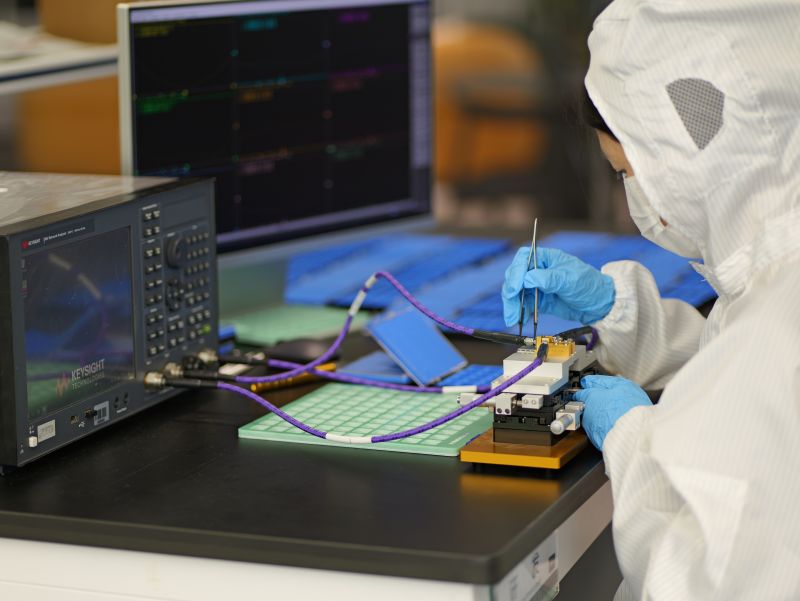
Small‑signal S‑parameters are measured with calibrated vector network analyzers using fixtures that emulate the production launch geometry. TRL calibration near the device plane is preferred at higher frequencies; SOLT may suffice at L/S bands if well executed. Large‑signal testing validates average‑ and peak‑power handling with controlled duty cycles, while spectrum analyzers monitor spurious emissions and intermodulation products under drive. Time‑domain reflectometry (TDR) or time‑domain transmission (TDT) reveals launch discontinuities and bonding‑layer thickness anomalies that correlate with ripple and IL growth.
9) Application snapshots
- Air defense radar (X‑band): High‑power drop‑in circulators route PA output to the antenna while protecting the chain during high‑VSWR startup or environmental detuning (icing, radome wetting).
- Maritime surveillance (S/C‑band): Corrosive environments demand robust plating and sealed housings; wide temperature swings require stable bias and CTE‑matched joints.
- EW receivers (L/S‑band): Low IL preserves sensitivity while reverse isolation helps prevent LO leakage paths. Packaging must survive shock, vibe, and thermal transients on tracked vehicles or aircraft.
- Military SATCOM (X/Ku‑band): Drop‑ins inside T/R modules minimize footprint versus coaxial parts while still handling power for high‑EIRP uplinks.
10) Procurement checklist
Performance & Data
- Swept IL/Isolation/VSWR across guaranteed bandwidth (typ & max)
- Phase linearity and group delay ripple
- Average and peak power ratings with duty cycle assumptions
Materials & Build
- Ferrite composition and linewidth (ΔH); magnet grade; bias uniformity
- Plating stack, surface roughness on current‑carrying paths
- Adhesive types, bond‑line thickness control, CTE harmony
Reliability & Qualification
- MIL‑STD‑202/810 test reports; burn‑in and reverse‑power soak
- Lot‑to‑lot Cp/Cpk for IL and isolation; failure analysis process
- Salt‑fog/humidity protection and corrosion mitigation
Conclusion
High‑power drop‑in circulators marry non‑reciprocal ferrite physics with rugged packaging and precision matching to deliver low insertion loss and high isolation under punishing mission profiles. For defense‑grade platforms, success is earned through disciplined S‑parameter engineering, thermal design that respects both average and pulse power, and reliability programs that stand up to MIL‑standard scrutiny. With bandwidths expanding and EIRP targets climbing, the competitive edge belongs to teams that compress IL without sacrificing survivability, while standardizing materials and transitions across SKUs to control variability at scale.
FAQ
How low should insertion loss be for a military‑grade drop‑in circulator?
Typical targets run 0.2–0.5 dB across the guaranteed bandwidth, with narrowband designs achieving lower IL at the cost of size or magnet volume.
What is the difference between a drop‑in and a coaxial circulator?
Drop‑ins mount directly into a PCB cavity for compact integration; coaxial parts use connectors and may offer easier bench testing but larger footprint. Both can be engineered for high power, but drop‑ins excel in T/R modules and dense front‑ends.
How do I interpret peak vs average power in the datasheet?
Average power is a steady‑state thermal limit; peak power specifies survivability during pulses with given width and duty cycle. Ensure the stated assumptions match your waveform.
Can a circulator act as an isolator?
Yes—terminating the third port with an appropriately rated matched load yields isolator behavior. For high‑power systems, verify the load’s reverse‑energy dissipation and thermal path.
Which standards matter for military‑grade acceptance?
MIL‑STD‑202 and MIL‑STD‑810 are common for environmental and mechanical testing. Many programs add burn‑in and reverse‑power soak tests tailored to mission profiles.
Relateds




About the Author

HzBeat Editorial Content Team
Sara is a Brand Specialist at Hzbeat, focusing on RF & microwave industry communications. She transforms complex technologies into accessible insights, helping global readers understand the value of circulators, isolators, and other key components.