Dual-Junction Circulator: Doubling Power Handling and Stability in RF Systems | HzBeat
Discover how dual-junction circulators improve isolation, reduce insertion loss, and enhance reliability for radar, satellite, and 5G RF systems. Learn design principles and applications from HzBeat, a leading RF component manufacturer.
 Updated on: Dec 15, 2025
 Author:
Introduction
In the ever‑advancing landscape of microwave and RF technology, engineers demand higher isolation, wider bandwidth, and greater power tolerance from passive components. Among these, the dual‑junction circulator has emerged as a refined solution—offering improved performance beyond conventional single‑junction designs. Whether used in radar front‑ends, satellite payloads, or 5G transceivers, dual‑junction circulators deliver the robustness modern communication systems rely on.
What Is a Dual-Junction Circulator?
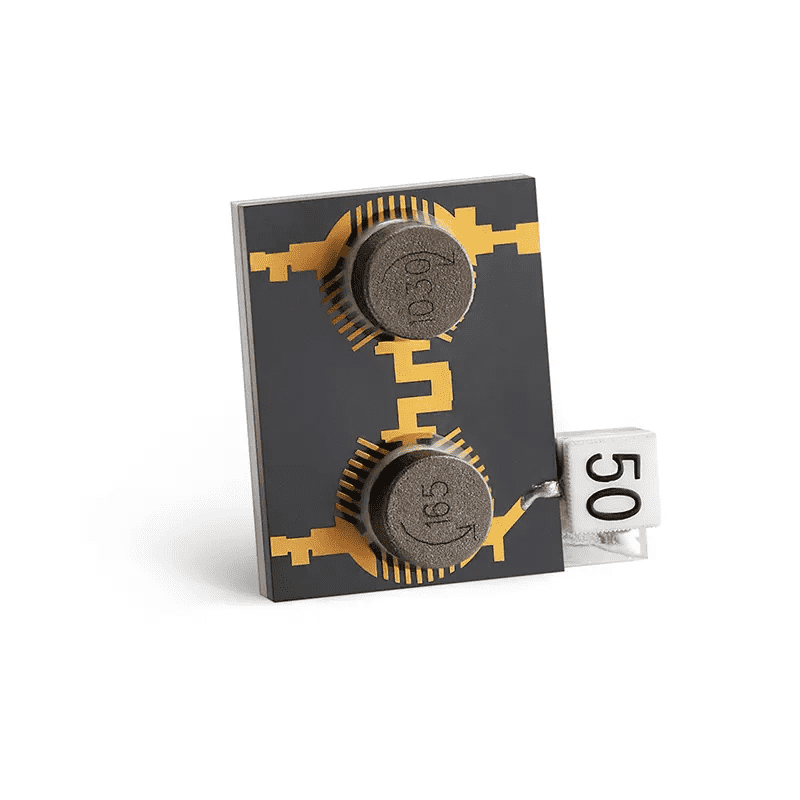
A circulator is a non‑reciprocal three‑port device that routes microwave power sequentially from port‑1 → port‑2 → port‑3, protecting transmitters from reflected energy. A dual‑junction circulator integrates two ferrite junctions within a single housing, effectively doubling the path for electromagnetic energy rotation and achieving higher power handling, lower insertion loss, and enhanced thermal balance—critical for high‑power radar transmitters and multi‑band RF front‑ends.
Core Working Principle
Each ferrite junction operates under a static magnetic bias, breaking time‑reversal symmetry and enabling non‑reciprocal propagation. When two junctions are aligned magnetically and geometrically, they form a cascaded structure—enhancing isolation while maintaining impedance balance. In system terms, the combined scattering matrix of two matched circulators reduces reflection coefficients and flattens phase response across frequency.
Design Advantages over Single-Junction Models
| Parameter | Single-Junction | Dual-Junction | Improvement |
|---|---|---|---|
| Isolation (dB) | 20–25 | 30–40 | +10–15 dB |
| Insertion Loss (dB) | 0.3–0.5 | 0.15–0.25 | −40% |
| Power Handling (W) | ≤ 100 | ≥ 200 | ×2 |
| Temperature Stability | Moderate | Excellent | — |
Applications in Modern RF Systems
- Phased‑Array Radars: Stable phase coherence across T/R modules.
- Satellite Communication: Protects HPAs (TWTAs/SSPAs) from reflected power.
- 5G Base Stations: High‑isolation duplexing in massive MIMO systems.
- Industrial/Plasma: Manages energy circulation in microwave processing.
Key Design Considerations
Evaluate ferrite material (low‑loss garnet), bias field strength and uniformity, thermal path (Cu/AlN spreaders), connector or transition integrity (SMA/N‑type/waveguide), and mechanical alignment versus crystal axes. Advanced EM simulation (HFSS/CST) expedites convergence before prototyping.
Testing and Performance Validation
- S‑parameters: IL/Return Loss/Isolation on a calibrated VNA.
- Power Burn‑In: Long‑term stability at rated power and temperature.
- Thermal Shock: Rapid swings to screen magnetic drift.
- Environmental: For aerospace, verify altitude/pressure per spec.
Conclusion
The dual‑junction circulator represents a practical evolution in ferrite technology—bringing enhanced robustness, reduced insertion loss, and superior thermal endurance. As RF architectures scale in power and frequency, this device class remains central to system reliability across defense, aerospace, and telecommunication sectors.
FAQs
Q: How is a dual‑junction circulator different from an isolator?
A: An isolator is a two‑port derived from a circulator with one port terminated. Dual‑junction circulators can be paired with a matched load to form high‑power isolators.
Q: What frequency range can it cover?
A: Typical engineered ranges span 500 MHz to 40 GHz, subject to ferrite/geometry.
Q: Do you support OEM/ODM?
A: Yes—custom footprints (microstrip, drop‑in, waveguide) and thermal solutions are available.
References
- Pozar, D. M. Microwave Engineering, 5th Ed., Wiley, 2022.
- Rizzi, P. A. Microwave Engineering: Passive Circuits, Prentice‑Hall, 1988.
- HzBeat Technical Papers – High‑Power Ferrite Circulator Design Series (2025).
 Article Tags
Keith Wong
Marketing Director, Chengdu Hertz Electronic Technology Co., Ltd. (Hzbeat)
Keith has over 18 years in the RF components industry, focusing on the intersection of technology, healthcare applications, and global market trends.