What Is a Coaxial Circulator?
An in-depth engineering guide to Coaxial Circulators. Learn how rf circulator and ferrite circulator technologies protect high-power RF systems, manage reflections, and improve long-term reliability through system-level design insight.
 Updated on: Jan 14, 2026
 Author:
A System-Level View of the Coaxial Circulator
In RF engineering, most system failures are not caused by lack of gain or insufficient bandwidth. They are caused by energy going where it was never intended to go. Reflected power, transient mismatch, and unstable loads are the silent stressors of high-power RF systems. A Coaxial Circulator exists to control this behavior at the system level.
Unlike many RF components that are optimized for signal processing or frequency conversion, a coaxial rf circulator is fundamentally a protection and stability device. It does not improve modulation quality or spectral purity. Instead, it ensures that when the system deviates from ideal conditions—as it inevitably will—the damage is limited and predictable.
What Engineers Mean by a Coaxial Circulator
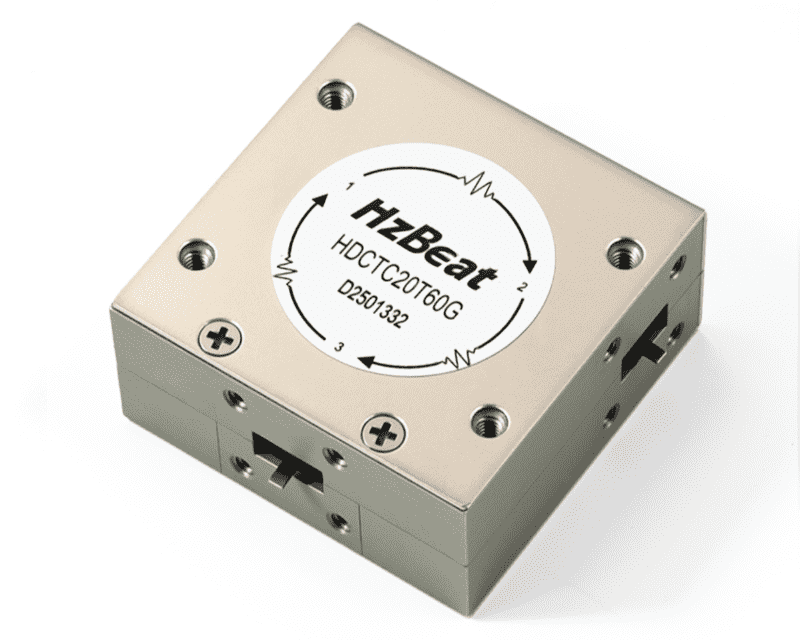
From an engineering perspective, a Coaxial Circulator is a three-port, passive, non-reciprocal rf circulator implemented using coaxial transmission geometry. Power entering one port exits the next port in sequence, while reverse power is redirected rather than reflected.
The defining characteristic is not the number of ports, but the non-reciprocal behavior enabled by a ferrite circulator junction under magnetic bias. This allows the device to enforce directionality without active control, switching logic, or feedback loops.

Where the Coaxial Circulator Sits in the RF Chain
In most RF architectures, the coaxial circulator is placed immediately after the final power amplification stage. This location is deliberate. It ensures that the most sensitive and expensive components—the output transistors or tubes— are shielded from load-induced stress.
In transmit/receive systems, the circulator may also act as a passive duplexing element, separating outgoing and incoming signals without the timing complexity of RF switches. In these configurations, the circulator is less about isolation between ports and more about preserving linearity and survivability under dynamic conditions.
Physical Construction and Materials
A coaxial circulator is mechanically simple but materially specialized. The core consists of ferrite elements positioned at a junction where electromagnetic fields can interact strongly with the magnetic bias. Permanent magnets provide the static field required for non-reciprocal operation.
The coaxial geometry offers two major advantages over planar structures: higher current capacity and more uniform field distribution. Combined with a metal enclosure, this construction allows the circulator to tolerate higher continuous-wave and peak power levels without localized heating or breakdown.
Ferrite Circulator Physics Without the Math
Ferrite materials respond to magnetic bias in a way that alters how RF waves propagate through them. Instead of treating forward and reverse waves symmetrically, the ferrite introduces a directional preference. This is the physical origin of circulation.
Importantly, this behavior is passive and broadband within a designed frequency range. There is no control signal, no calibration loop, and no timing dependency. This is why ferrite circulators remain relevant even as RF systems become more digitally complex.
Performance Parameters That Actually Matter
Datasheets list many parameters, but experienced engineers focus on a small subset. Insertion loss affects thermal loading and efficiency. Isolation determines how much reverse power is suppressed. Power handling defines the safe operating envelope under worst-case mismatch.
Less obvious—but equally important—are temperature stability and long-term drift. A coaxial circulator that meets specifications only under laboratory conditions but degrades in the field offers little real protection.
Failure Modes & What Happens Without a Circulator
Without an rf circulator, reflected power is free to interact directly with the output stage of the transmitter. This interaction is rarely benign. High VSWR increases voltage swing, raises junction temperature, and can push devices into unstable operating regions.
In solid-state systems, this often leads to gradual degradation rather than immediate failure. Gain compression, intermittent oscillation, and reduced efficiency appear long before catastrophic damage. In vacuum tube systems, the failure may be more sudden but equally costly.
A coaxial ferrite circulator mitigates these risks by diverting reflected energy into a controlled termination. It does not eliminate mismatch, but it prevents mismatch from becoming destructive.
Coaxial vs. Microstrip vs. Waveguide Circulators
Coaxial circulators occupy a middle ground. They handle significantly more power than microstrip designs and are easier to integrate than waveguide components. Waveguide circulators dominate at very high frequencies and power levels, but at the cost of size and mechanical complexity.
For most sub-millimeter-wave systems where flexibility and robustness are required, the coaxial approach offers the most balanced solution.
How Engineers Decide to Use a Coaxial Circulator
The decision to include a coaxial circulator is rarely driven by nominal performance. It is driven by risk assessment. Engineers ask: What happens if the antenna fails? What happens during startup? What happens after years of thermal cycling?
When the answers involve expensive downtime or difficult field repairs, the circulator becomes an obvious inclusion.
Application-Specific Considerations
Radar systems prioritize peak power handling and recovery time. Wireless infrastructure prioritizes long-term stability and low maintenance. Test systems prioritize repeatability and source protection. The same rf circulator principle serves all of these goals, but selection criteria differ.
FAQ
Is a coaxial circulator always required?
No. In low-power, tightly controlled environments it may be optional. In high-power or variable-load systems, it is often essential.
Does a circulator reduce system efficiency?
Slightly, due to insertion loss. In practice, this loss is far smaller than the efficiency penalty caused by operating a stressed or unstable amplifier.
References
- D. M. Pozar, Microwave Engineering, Wiley.
- IEEE MTT-S publications on non-reciprocal RF devices.
- Ferrite material literature for high-power RF components.
Recommended Products
 Article Tags
Sara
Sara is a Brand Specialist at Hzbeat, focusing on RF & microwave industry communications. She transforms complex technologies into accessible insights, helping global readers understand the value of circulators, isolators, and other key components.