How RF Circulators Support Quantum Computing Microwave Chains
A deep engineering guide to how RF circulators protect superconducting qubits, suppress amplifier backaction noise, manage reflections, and stabilize cryogenic microwave readout chains—plus selection and integration checklists for quantum labs.
 Updated on: Feb 26, 2026
 Author:
An engineering-first breakdown of how RF circulators make cryogenic quantum readout chains quieter: blocking amplifier backaction, routing signals cleanly, absorbing reflections, and improving long-term calibration stability—plus practical selection and integration checklists.
Introduction: In quantum computing, the most expensive resource is not “signal”—it’s “quiet”
In classic RF systems, the villains are obvious: out-of-band interferers, high-power reflections, and the nasty surprises of nonlinearities. In superconducting quantum computing, the enemy is subtler and more ruthless: noise. It shows up as amplifier backaction leaking upstream, reflections and standing waves reshaping readout pulses, thermal noise sneaking in through imperfect attenuation, and magnetic or mechanical perturbations that shift the operating point when you least want it to.
Superconducting qubits live in a world measured in millikelvin. Meanwhile, your measurement results must survive a long journey from the mixing chamber to room-temperature electronics without losing their meaning. That journey—the quantum computing microwave chain—is where RF circulators earn their keep. They do not boost power or decode qubit states. Their job is more fundamental: make sure what shouldn’t come back, doesn’t come back.
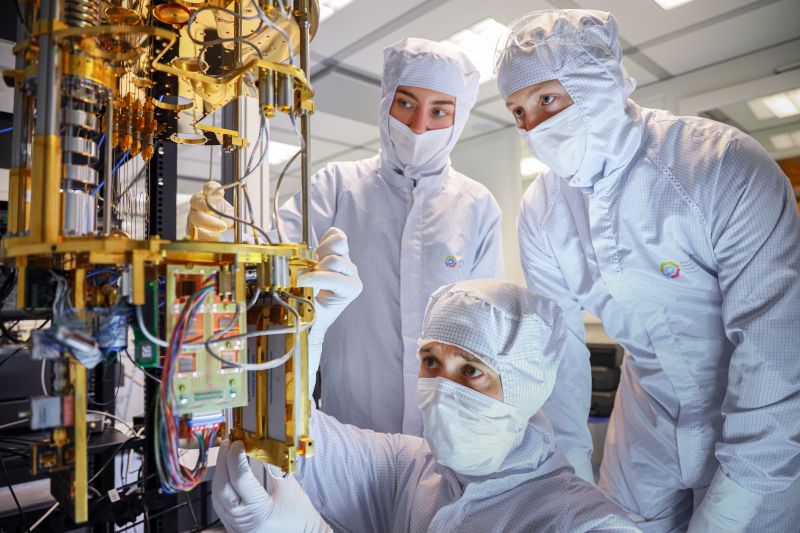
1. What is a “quantum microwave chain,” and what does it actually carry?
For the most common superconducting qubit architectures (for example, transmons), microwave infrastructure is typically split into two paths: a drive/control chain and a readout/measurement chain. Both paths run through multiple temperature stages of a dilution refrigerator: 300 K → 50 K → 4 K → 100 mK → 10–20 mK.
1.1 The drive chain (control path)
- Purpose: Deliver shaped microwave pulses to the chip to implement gates, excitation, and calibration sequences.
- Main challenge: “Cool the line down.” Attenuators and filters at different stages reduce room-temperature noise so it does not flood the qubit environment.
1.2 The readout chain (measurement path)
- Purpose: Carry weak readout signals that encode the qubit state toward amplification and demodulation at room temperature.
- Main challenge: Preserve signal-to-noise ratio while preventing amplifier noise from propagating backward into the qubit.
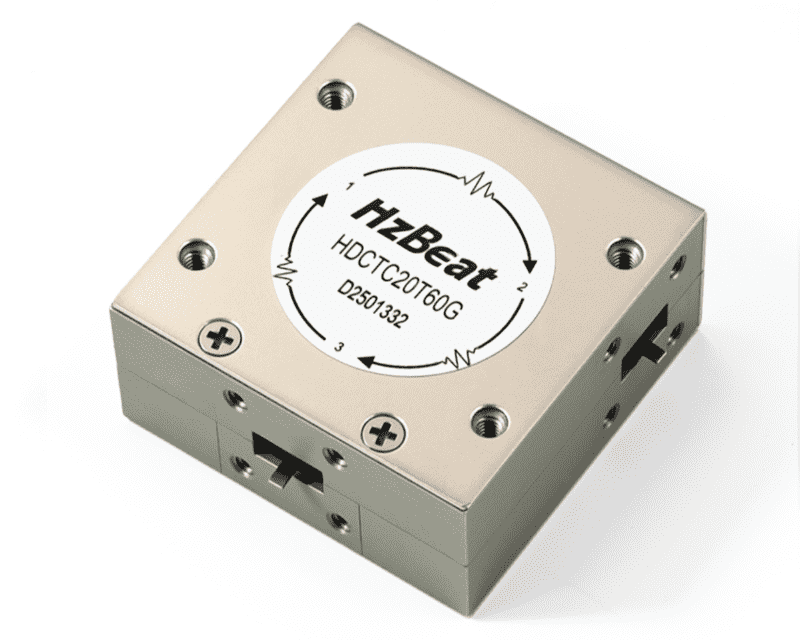
RF circulators are most commonly used near the cold end of the readout chain, between the chip (or resonator) and the first low-noise amplification stage (HEMT at 4 K, or a parametric amplifier such as JPA/JTWPA). Their role is to impose directionality and provide reflection management in a place where you can’t afford “RF chaos.”
2. Three “hard” jobs RF circulators do in quantum microwave chains
2.1 Suppress amplifier backaction noise: keep “heat” outside the qubit world
Every amplifier produces noise. Even a high-quality 4 K HEMT has an effective noise temperature that is enormous compared with a millikelvin environment. Without isolation, some portion of that noise travels upstream through the same coax and couples into the resonator and the qubit. The result can be unwanted excitation, dephasing, and readout instability.
A circulator leverages non-reciprocity: it routes the qubit’s outgoing readout signal toward the amplifier, while routing reverse-traveling noise and reflections toward a matched load (typically 50 Ω) where they are absorbed. This reduces the amplifier’s “measurement backaction” on the quantum system.
2.2 Clean routing: separate forward and return paths without self-interference
Many readout schemes share portions of the forward and return path. A 3-port circulator allows you to inject a probe tone at one port and collect the returning signal at another port, with less contamination from standing waves and imperfect couplers. Practically, this means you can build readout chains that are easier to calibrate and more stable across time.
2.3 Reflection and standing-wave management: make measurements repeatable
Cryogenic systems contain long cables, many connectors, and mechanical stress from thermal contraction. Small impedance mismatches create reflections; multiple reflections create standing waves; standing waves create frequency-dependent ripple in amplitude and phase. In quantum measurements, that ripple can alter the optimal readout point, degrade discrimination, and increase the “maintenance cost” of calibration.
By directing reflections to a matched load rather than back toward the chip, circulators reduce ripple and improve long-term repeatability—especially important for large datasets and quantum error correction experiments that demand stable measurement statistics.
3. The parameters that actually matter (and why)
Choosing a circulator for a quantum microwave chain is not the same as selecting one for radar, SATCOM, or a base station. In quantum readout, the “headline” is not power. The headline is noise budget and stability. Engineers typically scrutinize the following:
-
Insertion Loss (IL)
IL directly reduces the readout signal before it reaches the first amplifier. Because the readout signal is intrinsically weak, even small additional loss can measurably reduce SNR and slow down measurement—or increase assignment error. In practice, many labs treat IL as a “first-class” requirement.
-
Isolation
Isolation determines how effectively amplifier noise is prevented from reaching the qubit. Single devices often provide ~18–25 dB, but demanding systems cascade two (or more) stages to increase effective isolation, trading off added IL and volume.
-
VSWR / Return Loss
Mismatch contributes to reflections and ripple. Multi-qubit and multi-frequency readout architectures are particularly sensitive: poor matching inflates calibration workload and can create instability that looks like “random drift.”
-
Power Handling and thermal load
Readout powers are low, but control pulses, testing, and unexpected conditions can produce higher peaks. At cryogenic temperatures, the critical constraint is often heat leak and stage heating—not catastrophic failure.
3.1 Cryogenic behavior: don’t assume room-temperature specs translate
Many RF circulator datasheets are measured at room temperature, while quantum systems operate at 4 K, 100 mK, or lower. Material properties (including ferrite behavior), mechanical dimensions, and connector reliability can shift under cryogenic cycling. The safe engineering approach is to prioritize parts with cryogenic test data, or to validate performance with in-house measurements that include thermal cycling and repeatability.
3.2 Magnetic considerations: ferrites need bias; qubits dislike stray fields
Most conventional circulators rely on ferrites and magnetic bias to achieve non-reciprocity. Superconducting qubits, however, can be sensitive to stray magnetic fields. This creates a practical integration puzzle: placement, magnetic shielding (mu‑metal or superconducting shields), and routing must all be planned so the circulator helps the chain without becoming a hidden decoherence source.
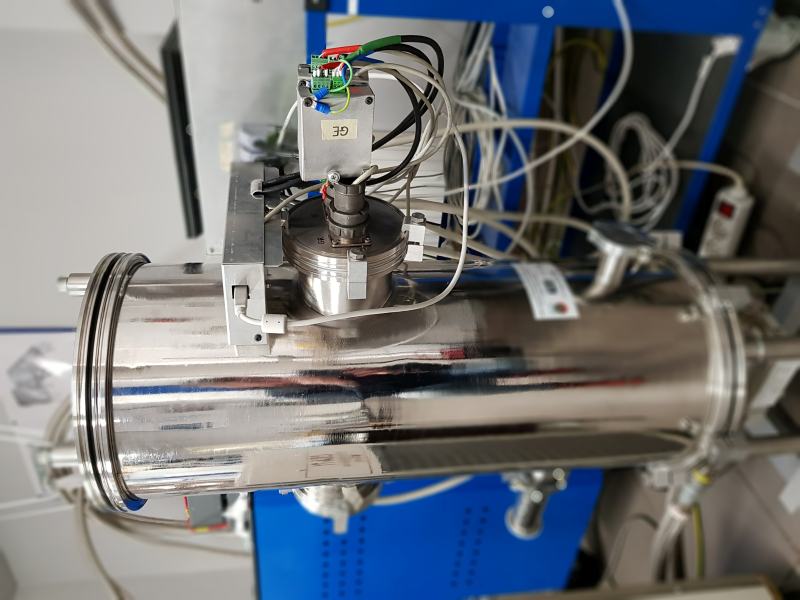
4. Typical topologies: where do you place circulators, and how many do you use?
4.1 A common readout chain (HEMT-based)
A widely used topology is: Qubit/Resonator → Circulator #1 → Circulator #2 → 4 K HEMT → room‑temperature amplification and demodulation. Two stages are used to push down the effective backaction from the HEMT and to reduce reflections seen by the chip. In engineering terms, this is a deliberate trade: more components and loss in exchange for calmer system behavior.
4.2 Parametric amplifiers (JPA/JTWPA) and the “reflection sensitivity problem”
When you use ultra‑low‑noise parametric amplifiers, the chain can become more sensitive to impedance environment and reflections. Circulators (and isolators) are often used not only to isolate the qubit, but also to stabilize the amplifier’s operating point, prevent gain ripple, and reduce the risk of oscillation. Many labs place isolation both before and after a parametric amplifier, depending on architecture.
4.3 A practical decision rule: 1 stage vs 2+ stages
- If you mainly need basic reflection management: one circulator may suffice, provided the load is well matched and the chain is simple.
- If you target high readout fidelity and low backaction: two cascaded devices are often justified, especially in multi-qubit systems and dense frequency multiplexing.
- If a parametric amplifier is involved and stability is challenging: isolation strategy is typically more complex and may exceed two stages.
5. System-level impact: how circulators translate into better readout
Ultimately, the metric you care about is the separation between readout distributions for |0⟩ and |1⟩ within a fixed measurement time. Circulators improve that separation primarily through two mechanisms:
- Lower effective input noise: by reducing upstream leakage of amplifier noise and reflections.
- Reduce ripple and drift: by managing reflections so calibrations remain valid longer and vary less across thermal cycles.
Quantitatively, labs often compare chain configurations using system noise temperature, readout SNR, assignment error, optimum readout frequency drift, and post-thermal-cycle reproducibility. A common pattern emerges: as systems progress from “it works” to “it works reliably,” the importance of circulator selection and placement rises dramatically.
6. Selection and integration checklist (engineer-friendly)
If you want to avoid expensive iteration cycles, treat the circulator as part of a system—not a standalone part number. The checklist below is designed for procurement and integration reviews:
- Frequency coverage and usable bandwidth: superconducting readout often sits around 4–8 GHz (but architectures vary). Cover your readout tones and tuning margin rather than chasing “maximum bandwidth” marketing.
- Cryogenic characterization: prioritize devices with verified cryogenic data (4 K or below), including statistics across samples and thermal cycles.
- IL/Isolation budget at the chain level: compute total IL and effective isolation for cascaded stages, and map them to SNR and readout error.
- Magnetic shielding plan: assume ferrite parts have a magnetic “footprint.” Plan shielding, spacing, and routing early rather than after problems appear.
- Connector and mechanical reliability: cryogenic cycling introduces stress; define torque, strain relief, and cable management practices.
- Heat leak and stage heating: every component and cable segment is a thermal path. Your limit may be base temperature stability rather than device survivability.
7. Scaling trends: what happens to circulators as quantum systems grow?
As qubit counts rise, conventional ferrite-based circulators face constraints: physical volume, magnetic management, and cost per channel. This is why the field explores more integrable non-reciprocal concepts (for example, parametric modulation, superconducting non-reciprocity, and on-chip implementations). However, for many near-term and mid-term platforms, ferrite-based cryogenic circulators remain the most mature, reliable choice—especially where repeatability and maintainability are key.
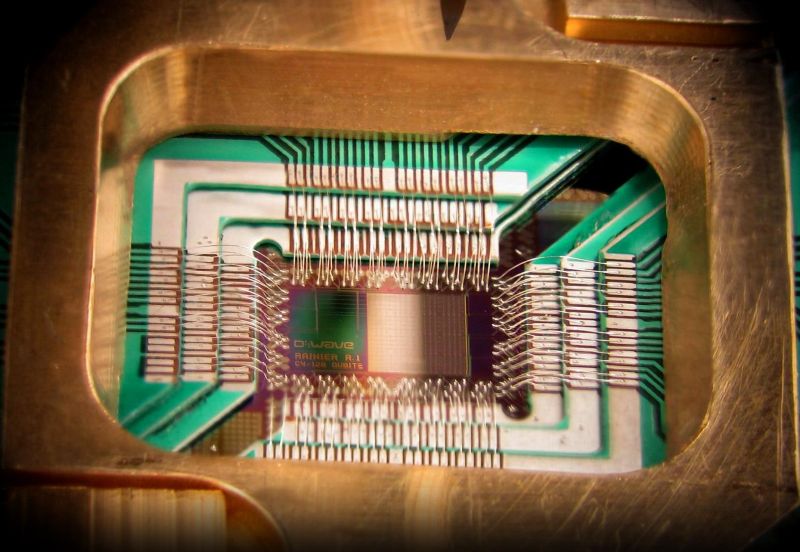
8. HzBeat perspective: from “possible” to “deliverable” cryogenic RF engineering
From a component supplier’s point of view, quantum hardware is not only a performance problem—it is a deliverability problem: consistency across units, lot-to-lot stability, repeatability after thermal cycling, and integration friendliness inside space‑limited cryostats. HzBeat’s long-term focus in RF/microwave passive components includes ultra‑wideband coverage and miniaturization. In quantum microwave chains, those strengths translate into practical value: flexible frequency planning, tighter mechanical integration, and more controllable routing within constrained cryogenic space.
If you are building or upgrading a quantum readout chain, it helps to frame the work at three levels: (1) noise budget, (2) reflections/standing waves and stability, and (3) cryogenic integration and magnetic management. Focusing only on a single datasheet line can be misleading—systems often fail at the interfaces between “good parts.”
Further reading: If you want a clean refresher on fundamentals, start here and then map back to your chain: What is an RF Circulator and How Does it Work?
For practical selection discussions, the most useful inputs are: target bands, interface type, IL/isolation targets, size constraints, and temperature-stage placement. Website: HzBeat ([email protected] / WhatsApp +86‑15388440404).
FAQ
Q1: Why do many quantum setups cascade two circulators?
Primarily to further suppress amplifier backaction noise and reduce reflections seen by the chip. The trade-off is extra insertion loss and volume, so you should balance it against your SNR and thermal budgets.
Q2: Can an isolator replace a circulator?
Often, yes. An isolator can be viewed as a two-port implementation derived from a circulator plus a termination. If you do not need 3‑port routing and only need one-way isolation, an isolator can be simpler.
Q3: Why is insertion loss so critical at cryogenic temperatures?
Because the readout signal is weak before the first amplifier, and any loss reduces SNR directly—SNR then maps to readout fidelity and measurement time. Quantum systems often care less about “detectable” and more about “stable, repeatable, fast.”
Q4: Do ferrite-based circulators risk affecting qubits through magnetic fields?
They can, depending on bias design, distance to the chip, shielding, and overall magnetic environment. Treat magnetic management as a first-order integration consideration, not an afterthought.
References
- Devoret, M. H., & Schoelkopf, R. J. (2013). Superconducting Circuits for Quantum Information.
- Krantz, P. et al. (2019). A Quantum Engineer’s Guide to Superconducting Qubits.
- Pozar, D. M. Microwave Engineering.
- Wikimedia Commons images used in this article under their respective licenses (see each figure caption).
Recommended Products
.jpg)
 Article Tags
Sara
Sara is a Brand Specialist at Hzbeat, focusing on RF & microwave industry communications. She transforms complex technologies into accessible insights, helping global readers understand the value of circulators, isolators, and other key components.