The Problem with Miniaturized RF Circulators: What Physics Won’t Let You Shrink Away
A rigorous, reference-backed deep dive into the real engineering problems behind miniaturized RF circulators and miniaturized RF isolators: bandwidth compression, insertion-loss penalties, isolation drift, thermal limits, and tolerance sensitivity.
 Updated on: Jan 29, 2026
 Author:
Miniaturization is the rhythm of modern RF hardware: smaller arrays, denser radios, tighter payloads, and more channels per cubic centimeter. But when it comes to RF circulators and RF isolators, “smaller” is not merely a packaging decision—it changes the electromagnetic problem itself. This deep-dive explains why Miniaturized RF Circulator and Miniaturized RF isolator designs often face bandwidth, loss, isolation, power-handling, and manufacturing sensitivity that are difficult to fully escape.
Introduction
In a perfect world, you would take a proven RF circulator, shrink its footprint, keep insertion loss low, preserve isolation, and call it a day. In reality, miniaturized RF circulators force a set of trade-offs that come from nonreciprocal physics, ferrite material behavior, bias-field constraints, and the hard fact that parasitics grow teeth as structures become electrically small.
Engineers rely on RF circulators to enforce one-way signal flow (Port 1 → Port 2 → Port 3 → Port 1), and on RF isolators to protect sources by terminating the third port. Textbook microwave engineering establishes the nonreciprocal foundations and network behavior of these devices, while ferrite-specific references detail the magnetized materials and junction theory that enable circulation.
1) What “Miniaturized” Really Means for RF Circulators
“Miniaturized” is often treated as a mechanical attribute, but for RF circulators it is fundamentally electromagnetic. A smaller housing is easy; a smaller nonreciprocal junction that preserves low loss and high isolation is the real challenge. In practical terms, Miniaturized RF Circulator implementations typically involve one or more of the following:
- Reduced ferrite volume (less interaction volume for nonreciprocal behavior)
- Shorter transmission-line lengths (reduced phase “real estate” for junction conditions)
- Higher field confinement (stronger sensitivity to dielectric/metal losses and discontinuities)
- More parasitic dominance (vias, pads, bond wires, transitions become “part of the circuit”)
These points are not marketing opinions; they are consistent with classical junction circulator theory and microwave network modeling discussed in standard references and ferrite-focused texts.
2) The Nonreciprocal Engine: Ferrite, Bias, and Junction Physics
The reason RF circulators exist at all is that magnetized ferrites create nonreciprocal propagation conditions. In the language of microwave theory, the junction supports modes whose phase relationships differ by direction, enabling circulation. A standard microwave engineering reference covers the network view (S-parameters, matched ports, isolation behavior), while ferrite engineering texts go deeper into how bias fields and ferrite properties shape the junction response.
Miniaturization stresses three linked elements:
- Bias field uniformity: as volume shrinks, maintaining uniform bias can become harder relative to the device geometry.
- Mode purity: smaller structures can more easily excite unintended modes or amplify coupling between ports.
- Material sensitivity: ferrite properties are frequency- and temperature-dependent; shrinking reduces margin for drift.
Classic work on stripline Y-junction circulators addresses the theoretical underpinnings of circulation and discusses frequency dependence and methods for broadbanding. This theoretical backbone helps explain why miniaturization often makes broadbanding harder: you have less physical “space” to realize the conditions the theory assumes.
3) Bandwidth Compression: Why Small RF Circulators Often Get Narrow
One of the most common complaints about miniaturized RF circulators is that “they’re wideband on paper, but not in my system.” Bandwidth in an RF circulator is not a single knob; it is an emergent property of junction conditions, matching networks, ferrite dispersion, and parasitics.
In classical circulator theory, frequency dependence appears naturally: the nonreciprocal response varies with frequency, and the scattering behavior changes as the junction moves away from its optimal operating point. Foundational treatments discuss frequency dependence and propose methods for broadbanding junction circulators.
Miniaturization tends to compress bandwidth for several reasons:
- Reduced effective interaction length: smaller line sections reduce the ability to shape phase conditions across frequency.
- Higher fractional parasitics: pad capacitance, via inductance, and transition discontinuities become comparable to the intended reactances.
- Stronger sensitivity to dielectric dispersion: substrate permittivity and thickness tolerances translate into larger electrical-length errors.
- Ferrite dispersion becomes “louder”: ferrite permeability/gyromagnetic behavior varies with frequency, and you have less margin to compensate.
The result is often a bandwidth that looks acceptable for isolation and return loss in a narrow central region, then degrades quickly at band edges. If your application is a tightly-defined channel, a Miniaturized RF Circulator can be excellent. If your application is “wideband because the spec sheet said so,” you may see unexpected ripple, elevated VSWR, or isolation collapse at edges.
This is also why many engineers find that system-level bandwidth (with real transitions, connectors, and PCB launches) is narrower than device-level test-fixture bandwidth. The circulator is not lying; it is simply being asked to perform in a different electromagnetic environment than the idealized fixture it was characterized in.
4) Insertion Loss vs. Size: Where the dB Goes When You Shrink
Low insertion loss is the selling point of many RF circulators. However, shrinking tends to increase loss contributions that were previously second-order. In microwave engineering, conductor loss, dielectric loss, and mismatch loss all play roles; in ferrite devices, additional magnetic losses and bias-point effects also appear.
In a Miniaturized RF Circulator, insertion loss commonly rises due to:
- Higher current density and conductor loss: smaller cross-sections and tighter bends can elevate effective resistance.
- Dielectric loss sensitivity: field confinement in lossy dielectrics raises dissipation per unit length.
- Matching penalties: as bandwidth compresses, mismatch loss increases at edges and under real load conditions.
- Ferrite loss and bias drift: operating away from the optimal bias point can increase magnetic loss components.
There is an additional subtlety: miniaturization often forces designers to rely on tighter matching structures. Those structures can introduce their own losses, and they can be more sensitive to tolerance. In other words, some of the “lost dB” is not in the ferrite; it is in the compensation network needed to make a small junction behave.
For RF isolators (and especially a Miniaturized RF isolator), insertion loss is not just efficiency—it is thermal burden. Every fraction of a dB becomes heat in a compact space. So insertion loss problems in miniaturized RF circulators often show up later as temperature problems in miniaturized isolator deployments.
5) Isolation Drift and Mismatch Sensitivity in Miniaturized RF Circulators
Isolation is the protective promise of RF circulators and RF isolators. A system designer typically expects “good enough” reverse isolation to keep reflections from damaging a PA, desensitizing an LNA, or corrupting a measurement chain.
The problem: isolation is extremely sensitive to the precise balance of phase and coupling inside the junction. Classical analyses of Y-junction circulators show how scattering behavior depends on junction conditions and frequency.
Miniaturization can degrade isolation because:
- Port-to-port parasitic coupling increases (shorter distances, higher fringing fields).
- Unintended resonances become easier to excite (small cavities and package features can become resonant at operating frequencies).
- Bias non-uniformity causes imbalance (especially in compact magnetic circuits).
- Temperature drift moves the operating point (ferrite and magnet behavior are not perfectly constant).
Now add mismatch: many real RF loads are not perfectly matched, and mismatch creates standing waves that modulate port impedances. Large devices often have more margin; a Miniaturized RF Circulator may have less tolerance to impedance excursions and can show larger isolation swing versus VSWR.
This is where “it passes on the bench” becomes “it fails in the radio.” The bench fixture likely presented a stable match and a stable temperature. The radio presents temperature gradients, load pulls, and board-level transitions. Small devices amplify environmental differences.
6) Power Handling and Thermal Bottlenecks: The Quiet Limiter
Power handling is often the cliff edge for miniaturized RF circulators. Even if insertion loss and isolation look acceptable at low power, increasing power exposes thermal constraints: less surface area, less thermal mass, fewer heat paths, and sometimes higher local field intensity.
The thermal story matters more for an RF isolator because the termination must absorb reflected power. A Miniaturized RF isolator may be asked to dissipate bursts of energy during mismatch events, and a compact load or package can heat quickly.
The practical consequences include:
- Performance drift: temperature changes shift ferrite and matching behavior.
- Bias point shift: magnets and ferrites can change characteristics with temperature; the “sweet spot” moves.
- Reliability risk: repeated heating cycles stress bonds, solder joints, and dielectrics.
7) Manufacturing Tolerances: Small Geometry, Big Consequences
One of the most underestimated problems with Miniaturized RF Circulator designs is that tolerance becomes destiny. When geometry shrinks, a fixed absolute error becomes a larger fraction of the design.
In microstrip/stripline implementations, small variations in:
- substrate thickness,
- dielectric constant,
- trace width/etch bias,
- via placement/diameter,
- bond wire length,
- connector or launch geometry,
can shift center frequency, elevate return loss, and reduce isolation more sharply than they would in a larger device. The same sensitivity applies to RF isolators derived from these junctions.
This tolerance sensitivity is not just a yield issue; it can become a field consistency issue. Two devices from different lots might both meet a datasheet, yet behave differently at your band edge. For wideband systems, that is a quality-of-experience problem, not merely a test-lab detail.
8) Miniaturized RF Isolator Specific Issues (Same Roots, Different Failure Modes)
An RF isolator is often described as “an RF circulator with the third port terminated.” That’s true structurally—and it is exactly why many of the problems of miniaturized RF circulators transfer directly into a Miniaturized RF isolator.
But isolators have their own stress patterns:
- Termination heating: reflected power becomes heat, and compact terminations saturate thermally faster.
- Mismatch events are harsher: isolators are often placed near PAs; load pulls can be severe.
- Failure looks “sudden”: an isolator can appear fine until a high-VSWR incident drives a thermal spike.
This is why it is risky to select a Miniaturized RF isolator purely on small-signal S-parameters. You also need reflected-power scenarios and thermal constraints, ideally with time-domain considerations (burst duty cycle, peak/average power).
9) When Miniaturization Makes Sense: Decision Framework
After all this, you might ask: “So should we avoid miniaturized RF circulators?” No. The better question is: What are you buying with the smaller footprint, and what are you paying with performance margin?
Miniaturization is usually the right choice when:
- Channel bandwidth is well defined and you can operate near the center of the device’s sweet spot.
- Power levels are controlled and mismatch events are limited or protected elsewhere.
- System density is the primary constraint (arrays, compact radios, embedded modules).
- Thermal design is deliberate (heat sinking, airflow, board copper, enclosure conduction paths).
Traditional, physically larger RF circulator solutions make more sense when:
- Wide bandwidth is mandatory with tight performance at band edges.
- High reflected power is likely (harsh load environment, uncertain antenna match).
- Long-term drift must be minimized (precision measurement, stable duplexers).
10) Practical Engineering Guidelines and Validation Tests
If you are integrating a Miniaturized RF Circulator or Miniaturized RF isolator into a real product, treat validation like an engineering story, not a checkbox. A strong validation plan typically includes:
10.1 Characterize Beyond Small-Signal S-Parameters
- S-parameters across temperature (insertion loss, isolation, return loss vs. temperature sweep)
- Band-edge verification with your exact launches/transitions
- Lot-to-lot variation checks if your volumes justify it
10.2 Mismatch and Reflected Power Stress Tests
- Isolation vs. VSWR (use mismatch tuners or reflective loads where possible)
- Thermal rise under reflection (especially for RF isolator use cases)
- Peak/average power duty cycles that mirror your modulation and burst behavior
10.3 Thermal Path Engineering
- Measure case temperature in enclosure, not just on open bench
- Design copper and mechanical heat paths for realistic worst-case environments
- Derate deliberately if load mismatch is uncertain
The guiding philosophy is: do not let your first thermal surprise happen in the field. Miniaturized components are brilliant when treated like precision instruments; they are unforgiving when treated like generic passives.
Conclusion
The problem with Miniaturized RF Circulator design is not that it is “bad”—it is that it is bounded. RF circulators and RF isolators depend on nonreciprocal ferrite physics and junction conditions that inherently carry frequency dependence, bias sensitivity, and loss mechanisms. Shrinking the structure reduces the margin to manage those realities.
In practice, the most common pain points of miniaturized RF circulators are:
- Bandwidth compression (especially at edges and in real board environments)
- Insertion loss creep (from parasitics, matching networks, and loss concentration)
- Isolation drift (with temperature, tolerance, and mismatch)
- Thermal limits (particularly for Miniaturized RF isolator deployments absorbing reflections)
The forward-looking takeaway is encouraging: miniaturization succeeds when it is paired with honest system constraints, careful thermal design, and validation that respects real mismatch and temperature conditions. In RF, smaller can be stronger—but only when you give the physics room to breathe.
FAQ
Q1: Are miniaturized RF circulators always narrower bandwidth?
Not always, but bandwidth often becomes harder to preserve because the junction has less physical slack and parasitics become a larger fraction of the effective circuit. Classical treatments of junction circulators explicitly show frequency dependence and motivate broadbanding strategies.
Q2: Is an RF isolator “easier” than an RF circulator?
A typical RF isolator is built from an RF circulator with a matched termination, so the core nonreciprocal problems remain. A Miniaturized RF isolator can be more thermally stressed because it must safely absorb reflected power in a compact package.
Q3: What specification is most likely to degrade first in a Miniaturized RF Circulator?
In many real systems, isolation at band edges and under mismatch is where problems appear first, followed by insertion loss rise under temperature. Your specific “first failure” depends on bandwidth demands, transitions, and power/mismatch environment.
Q4: How do I validate an RF circulator for a real product, not just a datasheet?
Validate across temperature, include your exact launches and packaging, and add mismatch/reflection stress tests. Treat it like a system component, not a standalone part.
Q5: Do textbooks cover this, or is it only in vendor notes?
Core principles are covered in standard microwave engineering texts and specialized ferrite/circulator literature, including classic junction theory and nonreciprocal microwave component treatments.
References
- D. M. Pozar, Microwave Engineering, 4th ed., Wiley.
- J. Helszajn, Nonreciprocal Microwave Junctions and Circulators, Wiley.
- H. Bosma, “On Stripline Y-Circulation at UHF,” IEEE Transactions on Microwave Theory and Techniques.
- Wiley title page for Pozar’s Microwave Engineering (edition and publication details).
- Semantic Scholar records for foundational circulator literature (metadata and publication indexing).
- (Supplementary) Example of modern modeling/validation work in microstrip ferrite circulators (design-oriented modeling paper PDF).
Note: The reference list intentionally emphasizes textbooks and foundational IEEE literature because they provide stable, widely accepted theoretical grounding for RF circulators, RF isolators, and the practical limits encountered during miniaturization.
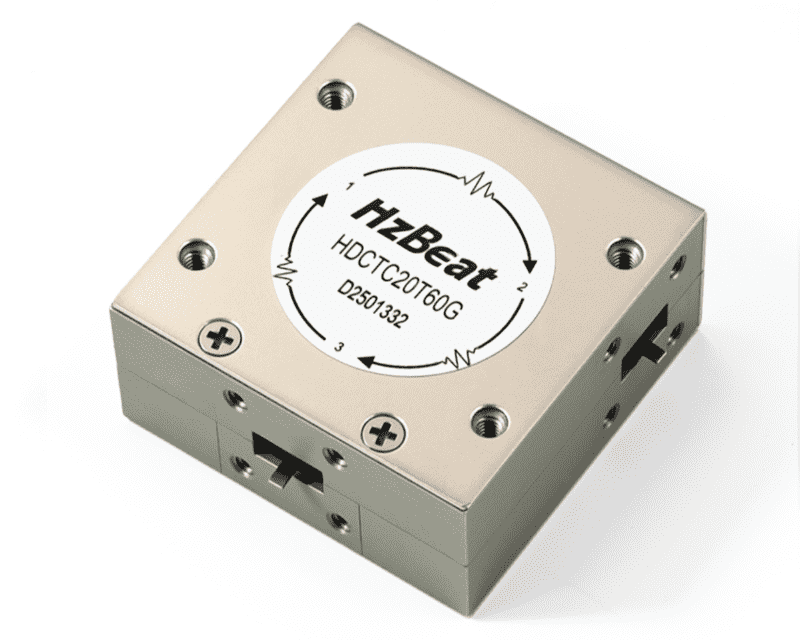
Recommended Products
.jpg)
 Article Tags
Sara
Sara is a Brand Specialist at Hzbeat, focusing on RF & microwave industry communications. She transforms complex technologies into accessible insights, helping global readers understand the value of circulators, isolators, and other key components.