Microwave Circulators for 5G and Microwave Backhaul Systems
A deep, system-level guide to microwave circulators in 5G radios and microwave/E-band backhaul—covering PA protection, isolation, insertion loss, package choices, and field reliability with practical selection criteria.
 Updated on: Jan 08, 2026
 Author:
In modern 5G networks, “capacity” is no longer a single metric—it’s a chain. Your radio can be spectacular, your antenna can be brilliant, but if the transport layer can’t move the bits reliably, the experience collapses. That’s why microwave and millimeter-wave backhaul continues to be a strategic pillar where fiber is unavailable, too slow to deploy, or too expensive to scale.
In that chain, microwave circulators rarely get the spotlight—yet they quietly decide whether RF power flows cleanly from the transmitter to the antenna, and whether reflected energy is safely routed away from sensitive circuits. In both 5G radio units and microwave backhaul radios, circulators are often the difference between “works in the lab” and “survives five summers and five winters on a tower.”

Why 5G and Microwave Backhaul Make Circulators More Critical
Backhaul is under pressure: higher capacity, higher frequency, tighter margins
As networks densify, backhaul links must carry more traffic per site with lower latency and higher availability. Traditional microwave bands (roughly below 42 GHz) remain widely deployed, while higher bands—especially E-band (71–86 GHz)—are used for fiber-like capacity over the air. Industry and regulatory material commonly references E-band as the paired ranges 71–76 GHz and 81–86 GHz.
Higher frequencies and wider channel bandwidths improve capacity, but they also reduce RF “forgiveness.” Small impedance changes, connector issues, weather effects, or antenna alignment drift can raise reflected power and destabilize the RF chain. The more aggressively you push throughput and spectral efficiency, the more valuable robust isolation becomes.
5G radios push RF hardware closer to its operating boundaries
In 5G radio units (RRU/AAU), especially those supporting high-power and high-efficiency power amplifiers, load mismatch and reverse power can trigger gain compression, spurious emissions, or long-term reliability degradation. A circulator (or isolator) provides a controlled path for reflected energy, helping keep the transmitter stable as the antenna environment changes.
If you’d like a quick refresher on the underlying non-reciprocal principle, HzBeat’s technical primer How Does an RF Circulator Work? is a solid internal reference point to link from product pages and application notes.
What a Microwave Circulator Actually Does in These Systems
PA protection: managing reverse power and mismatch
A 3-port circulator routes forward power from the transmitter to the antenna, while directing reflected power away from the transmitter port toward a termination (often an internal load). This matters because antennas don’t behave like perfect 50 Ω loads in the field. Ice, rain, nearby structures, loose connectors, cable aging, and installation tolerances can all worsen VSWR.
The engineering takeaway is simple: reflections are not rare corner cases. They are normal in real networks. A properly selected circulator reduces the chance that reverse energy forces your PA into unstable or inefficient behavior.
Tx/Rx isolation: keeping sensitive receivers alive in shared RF paths
While duplexing and isolation can also be achieved with filters and other structures, non-reciprocal devices remain useful in architectures that must share RF paths, reduce footprint, or maintain stable isolation over temperature. In practical designs, the “right answer” is often a combination: filtering for selectivity, and circulators/isolators for robustness against mismatch and reflections.
If your audience frequently confuses isolators and circulators, this internal explainer is an easy link to include: Isolators vs. Circulators in RF Systems, along with What Are RF Isolators?.

Where Circulators Sit Inside 5G Radio Units
Massive MIMO and thermal reality
In massive MIMO radios, dense integration and heat dissipation are constant constraints. Even small insertion-loss differences can matter, because they translate into power loss and heat. That’s why engineers often prioritize:
- Low insertion loss: improves efficiency and reduces thermal load.
- Stable isolation: protects RF stages as antenna conditions vary.
- Package suitability: supports compact layouts and reliable assembly.
Package choices: microstrip, drop-in, and coaxial in real deployments
There is no universal “best” package. The right circulator depends on your frequency, power, size constraints, and assembly flow:
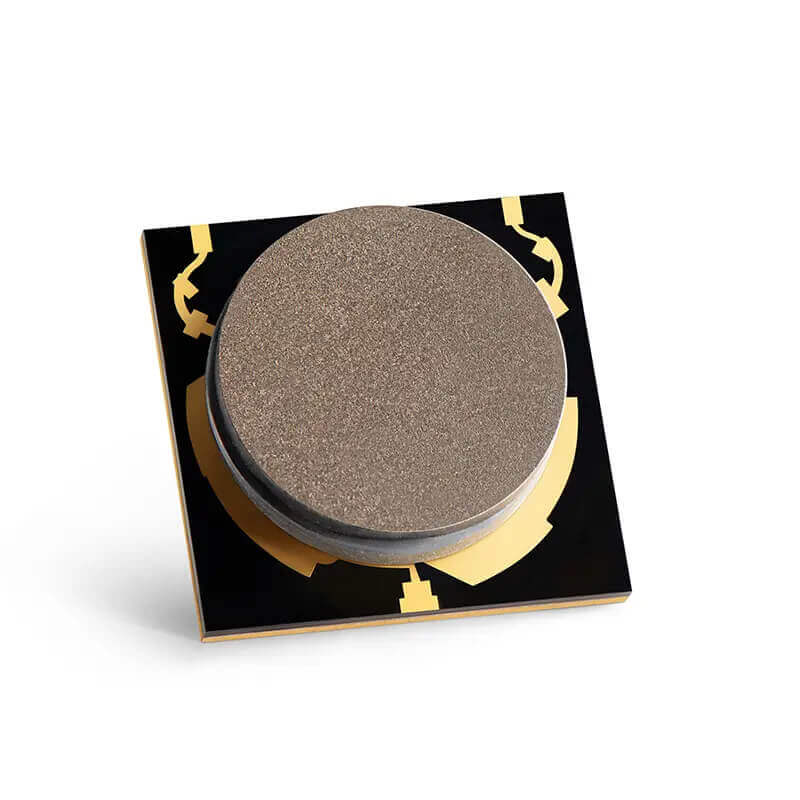
- Microstrip circulators are popular for compact RF front-ends and integrated modules. For an overview, see Typical Microstrip Circulator.
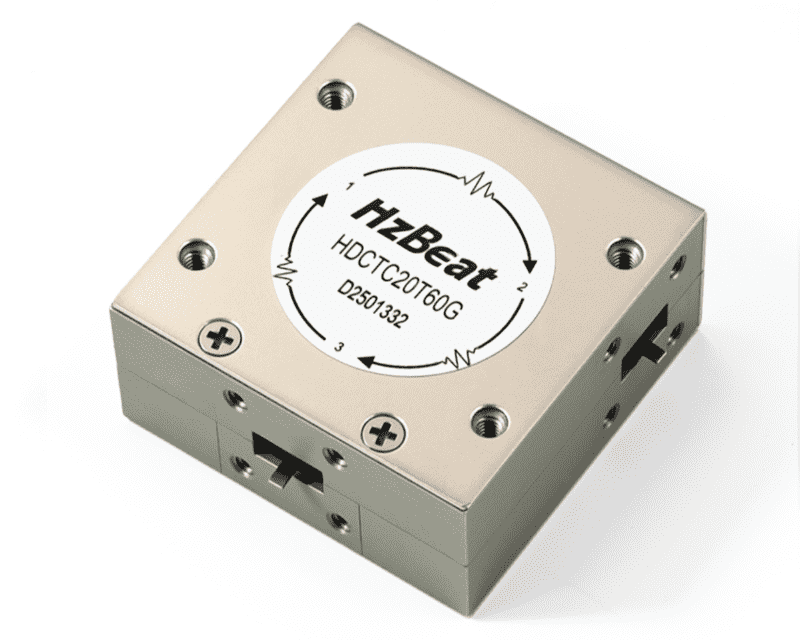
- Drop-in circulators fit designs that want a compact, straightforward integration approach: Typical Drop-in Circulator.
- Coaxial circulators are widely used where connectorized interfaces, serviceability, or higher power handling are key: Broadband Coaxial Circulators and High-Power Coaxial Circulators.
This naturally maps to two macro advantages in 5G deployments: ultra-wideband coverage (fewer part numbers to manage) and miniaturization (denser RF modules without sacrificing RF stability).
Where Circulators Sit Inside Microwave & E-Band Backhaul Radios
E-band backhaul needs high performance—and consistent performance
E-band (71–86 GHz) backhaul is widely positioned as a high-capacity option in the fixed service ecosystem. With wider channels and high-order modulation, RF chain linearity and stability become more sensitive to mismatch. That sensitivity is one reason designers pay attention to isolation and insertion loss of non-reciprocal components, especially under temperature variation.
Outdoor reliability: the “slow failures” that cost the most
The most painful failures are rarely dramatic. They are slow: a connector gets slightly worse, a radome accumulates grime, a mount loosens by a fraction, or temperature cycling changes mechanical stress. The radio still works—until it doesn’t. Good circulator selection helps prevent small degradations from turning into transmitter instability or repeated service calls.
The Selection Checklist That Actually Works
Insertion loss and isolation: treat them as system metrics, not datasheet decorations
It’s tempting to compare circulators by single numbers, but you’ll get better outcomes by converting them into system impact:
- Insertion loss → efficiency loss, heat increase, and potential EVM/linearity impact downstream.
- Isolation → how well the PA and receiver are protected when the antenna mismatch gets ugly.
- VSWR handling → stability under real antenna conditions, not ideal lab loads.
- Power handling → match peak/CW needs and duty cycles, especially for radios with high uptime.
Bandwidth and frequency planning: avoid “works today, blocks tomorrow”
5G transport networks evolve. Bands, channel widths, and deployment density can change faster than a typical hardware refresh cycle. A circulator with adequate bandwidth headroom can reduce redesign risk and help a platform cover multiple regional frequency plans.
When Waveguide Circulators Become the Right Answer
High power, low loss, and mmWave scaling
As frequencies climb and power remains non-trivial, waveguide solutions are often favored where ultra-low insertion loss and robust handling are required. HzBeat’s waveguide hub page provides a clean jumping-off point: Waveguide Circulator.
For a deeper rationale, see: Why Choose a Waveguide Circulator.
Practical Recommendations for Content and Product Page Linking
- Need the principle? How Does an RF Circulator Work?
- Need to compare devices? Isolators vs. Circulators
- Need a package choice? Microstrip, Drop-in, Broadband Coaxial, Waveguide
- Need isolation strategy? RF Isolator Knowledge Hub

FAQ
Do microwave backhaul radios really need circulators if the antenna is well matched?
A good antenna match helps, but it does not eliminate reflections over time. Outdoor deployments experience weather effects, connector aging, and mechanical drift. Circulators provide an extra safety margin that can prevent intermittent issues from turning into hard failures.
What is the difference between a circulator and an isolator in this context?
A circulator is typically a 3-port non-reciprocal device that routes power directionally between ports. An isolator is commonly a 2-port device derived from a circulator with a termination, used mainly for one-way protection. For a quick comparison, see Isolators vs. Circulators in RF Systems.
How low should insertion loss be for 5G and backhaul?
There isn’t a single universal number—because it depends on your power budget, heat constraints, and linearity targets. A practical method is to translate insertion loss into dissipated power and expected junction temperature rise, then verify margin across temperature and production spread.
Conclusion
In 5G and microwave backhaul systems, a microwave circulator is not just an RF accessory—it’s a reliability tool. It protects power amplifiers from the messy reality of antennas, preserves performance as environments change, and supports compact architectures where integration density is a competitive advantage.
If you’re building or upgrading 5G radio platforms or microwave/E-band transport links, treat circulator selection as a system decision: map insertion loss and isolation into your thermal, linearity, and reliability budgets, then choose the package type that matches your integration workflow and frequency roadmap.
References
- ITU-R materials on fixed service and E-band usage (71–76 / 81–86 GHz) and backhaul applications.
- FCC overview of 70/80/90 GHz service (71–76 / 81–86 / 92–95 GHz).
- GSMA backhaul overview.
- Analog Devices perspective on E-band backhaul capacity trends.
- Image sources: Unsplash photos used under the Unsplash License.
Recommended Products
.jpg)
 Article Tags
Keith Wong
Marketing Director, Chengdu Hertz Electronic Technology Co., Ltd. (Hzbeat)
Keith has over 18 years in the RF components industry, focusing on the intersection of technology, healthcare applications, and global market trends.