RF Circulators in Quantum Computing: How They Protect Superconducting Qubit Readout
Learn how an RF circulator in quantum computing routes superconducting qubit readout signals, blocks amplifier noise, and shapes scalable cryogenic systems.
 Updated on: Aug 17, 2026
 Author:
Quantum computing is usually explained through qubits, superposition, and entanglement. A working quantum processor, however, also needs a classical control and measurement system. In superconducting quantum computing, that interface is built largely from microwave engineering. Coaxial cables, attenuators, filters, amplifiers, isolators, and circulators carry extremely weak signals between room-temperature electronics and a quantum chip operating near absolute zero.
The relationship is specific rather than universal. An RF circulator in quantum computing is especially relevant to superconducting qubits, circuit quantum electrodynamics, and related microwave-frequency quantum devices. Trapped-ion, neutral-atom, and photonic quantum computers use different physical interfaces and do not depend on the same cryogenic microwave readout chain.
How Superconducting Qubit Readout Uses Microwaves
A superconducting qubit is commonly coupled to a microwave readout resonator. In the dispersive regime, the qubit state slightly shifts the resonator response. Engineers send a weak microwave probe near the resonator frequency and measure the amplitude and phase of the returning field. Different responses correspond to the qubit being in its ground or excited state.
The returning signal can contain only a small number of microwave photons, so it must be amplified with as little added noise as possible. A Josephson parametric amplifier is often placed close to the quantum chip at millikelvin temperature, followed by a cryogenic high-electron-mobility transistor amplifier at a warmer stage and further room-temperature electronics. High-fidelity single-shot readout is essential for feedback and quantum error correction.
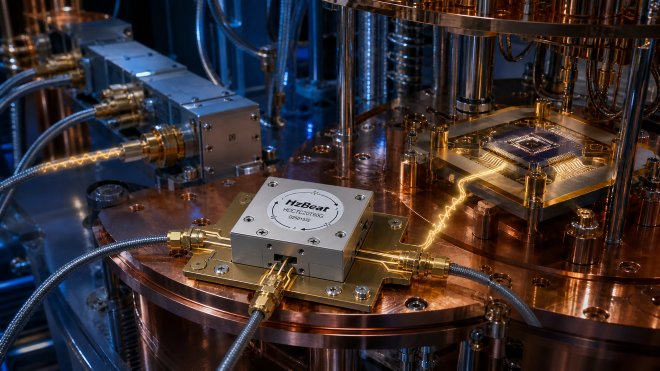
This is where the quantum computing RF circulator enters the chain. A conventional three-port circulator is nonreciprocal: energy travels from port 1 to port 2, from port 2 to port 3, and from port 3 back to port 1. That directional behavior lets one physical connection to the resonator carry both the incoming probe and reflected readout signal without sending both waves to the same destination.
What an RF Circulator Does in a Quantum Computer
It separates incident and reflected microwave signals
In reflection-mode readout, a microwave tone must reach the resonator and the much weaker reflected field must reach the amplifier. The RF circulator routes these waves according to direction. This separation reduces the need for separate resonator ports and helps the receiver capture the state-dependent response efficiently.
It protects the qubit from amplifier backaction
Amplifiers are not perfectly quiet or perfectly matched. Noise, pump leakage, and reflected energy can travel backward along the output line. A cryogenic RF circulator, often combined with additional circulators configured as isolators, attenuates this reverse path. Published superconducting-qubit experiments show that nonreciprocal microwave devices are important both for signal routing and for protecting qubits from noise generated by the output chain.
It preserves scarce readout signal power
Every fraction of a decibel matters before the first amplifier. Insertion loss between the resonator and amplifier reduces measurement efficiency and makes qubit states harder to distinguish. A useful RF circulator in quantum computing therefore needs low forward loss as well as strong reverse isolation. Adding more isolation stages improves protection but also adds loss, so designers optimize the complete chain.
It supports reflective quantum-limited amplifiers
Many Josephson parametric amplifiers operate in reflection. The same port receives a weak signal and returns an amplified version. A circulator sends the input to the amplifier and then diverts the amplified reflection toward the next stage. The component is therefore both a qubit-interface device and an amplifier-routing device.
Why a Cryogenic RF Circulator Is Not an Ordinary RF Component
A commercial room-temperature circulator cannot automatically be placed beside a quantum processor. The component must remain predictable under deep cryogenic conditions and must not create an unacceptable thermal, magnetic, or loss penalty.
| Requirement | Why It Matters |
|---|---|
| Low insertion loss | Loss before the first amplifier directly lowers measurement efficiency and readout signal-to-noise ratio. |
| High reverse isolation | Isolation suppresses amplifier noise, pump leakage, and thermal radiation traveling toward the qubit. |
| Cryogenic frequency stability | Ferrite, dielectric, and mechanical properties can shift during cooldown, changing match, isolation, and center frequency. |
| Sufficient bandwidth | Frequency-multiplexed readout may place many resonators and amplifier channels across a multi-gigahertz band. |
| Magnetic compatibility | Stray magnetic field and trapped flux can disturb superconducting circuits, so shielding and placement require care. |
| Small size and low heat load | Dilution refrigerators offer limited cold-stage space and cooling power; every package and coaxial connection adds overhead. |
Why Traditional RF Circulators Become a Quantum Scaling Problem
Ferrite circulators are mature, broadband, and straightforward to use, but their strengths come with system costs. Conventional units use magnetic materials and a bias field. They are large compared with a qubit or on-chip resonator, require shielding near superconducting hardware, occupy space at refrigerator stages, and need connectors and coaxial cables. Their insertion loss also consumes part of the readout-efficiency budget.
These limitations are manageable in a laboratory experiment with a few qubits. They become more serious when one measurement line serves many frequency-multiplexed resonators and when a processor needs many parallel readout channels. Quantum error correction requires repeated, reliable measurement, so the supporting microwave chain must scale along with the qubit count.
A 2023 demonstration of a passive superconducting circulator on a chip described integration-compatible circulation as a key element for scaling superconducting circuits. A 2025 follow-up reported a ferrite-free Josephson-junction design with optimized on-resonance insertion loss of 0.2 dB, isolation of 18 dB, and circulation fidelity above 97%. These results explain why miniaturized nonreciprocal devices are an active research area, while also showing that bandwidth, fabrication tolerance, and power handling remain real constraints.
On-Chip Circulators and Circulator-Free Readout
The future of the RF circulator in quantum computing may not follow one technology. Several approaches are being developed in parallel:
- Josephson circulators and isolators use superconducting nonlinear circuits to create nonreciprocity without a bulky ferrite package.
- Parametrically driven directional devices combine gain, directionality, and isolation, potentially reducing separate components.
- Quantum Hall and synthetic-rotation devices seek compact on-chip circulation through alternative nonreciprocal physics.
- Electro-optic readout converts microwave information to the optical domain and can remove parts of the cryogenic microwave output chain.
- Thermal and photon-counting detectors explore readout without a standard voltage-amplifier chain.
Circulator-free does not mean constraint-free. A replacement must still control backaction, added noise, pump leakage, bandwidth, dynamic range, fabrication variation, and heat dissipation. Researchers have demonstrated all-optical single-shot superconducting-qubit readout without a circulator, as well as compact traveling-wave parametric devices that combine forward gain with backward isolation. Conventional cryogenic circulators nevertheless remain a practical reference solution in many experiments.
How Engineers Should Evaluate a Circulator for Quantum Research
Selecting an RF circulator for quantum computing starts with the complete measurement architecture. Engineers should define resonator and amplifier bands, allowable loss before the first amplifier, reverse-isolation target, operating temperature, magnetic-field constraints, connector format, available cold-stage space, and the number of multiplexed channels.
Room-temperature S-parameters alone are not enough. Request or measure cryogenic insertion loss, isolation, return loss, and stability after repeated thermal cycles. Check whether the published bandwidth meets all limits at the same time. Because impedance mismatch creates standing waves, evaluate the circulator together with the resonator, cables, filters, and amplifier it will actually see.
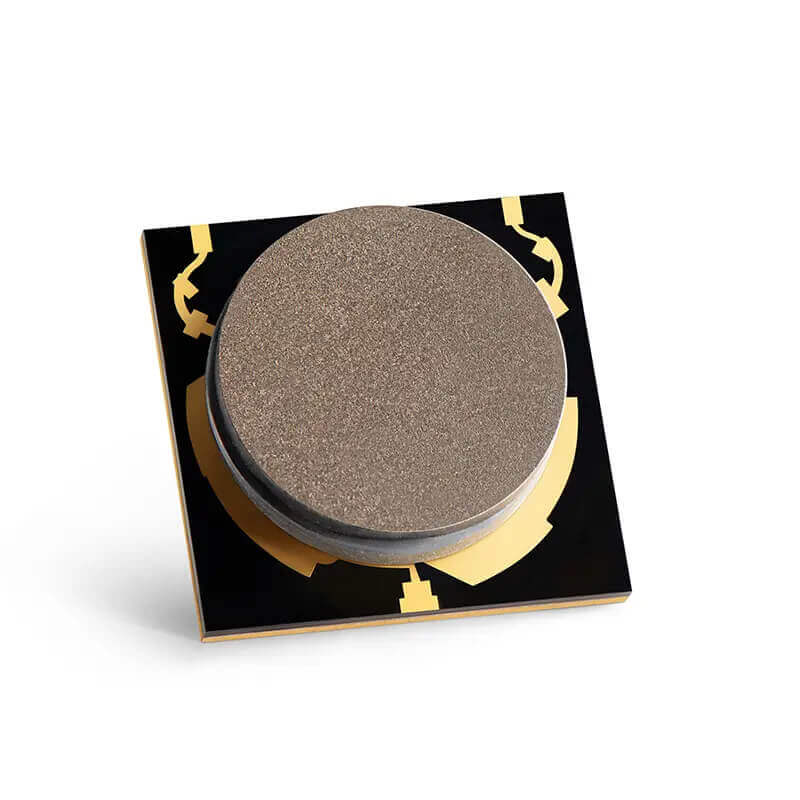
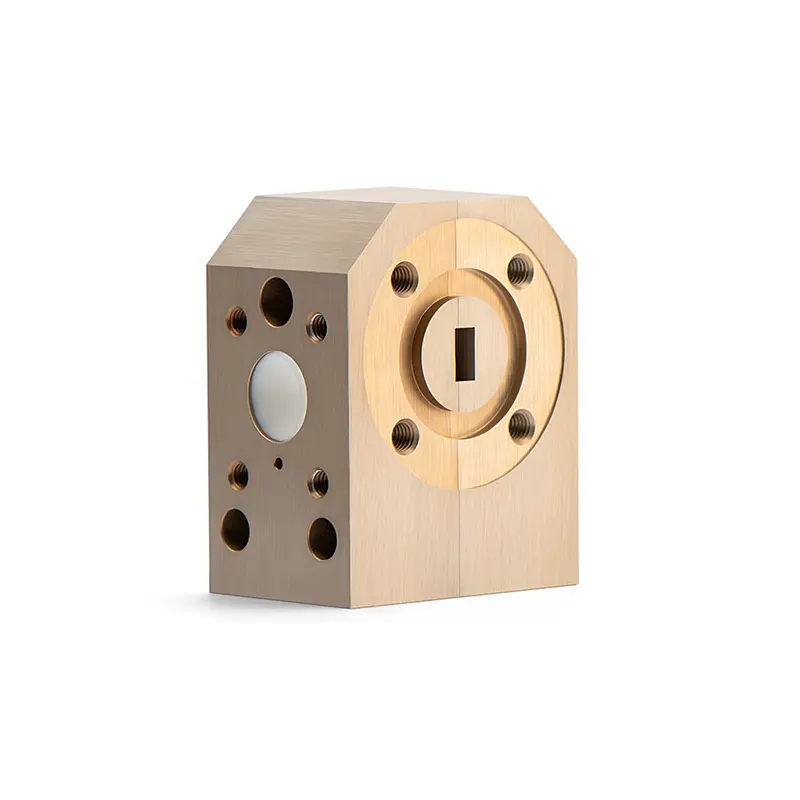
HzBeat supplies RF circulators in microstrip, drop-in, coaxial, and waveguide formats, as well as RF isolators for directional protection. Quantum and deep-cryogenic use requires application-specific validation; standard catalog ratings should not be assumed to represent millikelvin performance without test data.
Conclusion
An RF circulator in quantum computing is a classical microwave component serving an unusually delicate quantum task. It directs the probe toward a superconducting readout resonator, routes the returning qubit-state signal toward a low-noise amplifier, and reduces the noise that can travel backward into the quantum circuit.
That combination of signal routing and protection makes the circulator valuable for high-fidelity qubit measurement. It also explains why size, magnetic bias, insertion loss, and cryogenic integration have become scaling concerns. Traditional ferrite devices, emerging on-chip superconducting circulators, directional amplifiers, and optical readout are all part of the same objective: move information away from the qubit without allowing the measurement apparatus to disturb it.
FAQ
What does an RF circulator do in quantum computing?
It routes a microwave probe toward the superconducting-qubit readout resonator, sends the reflected state-dependent signal toward the amplifier, and helps block output-chain noise from returning to the qubit.
Do all quantum computers use RF circulators?
No. The strongest relationship is with superconducting qubits and other microwave quantum systems. Ion, neutral-atom, and photonic platforms use different control and measurement hardware.
What frequency does a quantum computing RF circulator use?
There is no single frequency. Superconducting-qubit readout commonly operates in the microwave range, often several gigahertz, but the correct band follows the resonator and amplifier design.
Why are cryogenic RF circulators difficult to scale?
Conventional devices consume cryostat space, add loss and cabling, use magnetic bias, and may require shielding. Those costs multiply as the number of parallel readout channels grows.
Can a superconducting qubit be read without a circulator?
Yes. Researchers have demonstrated directional Josephson devices, electro-optic conversion, and all-optical readout. Each alternative must still manage noise, backaction, bandwidth, and integration.
Can a standard HzBeat circulator be used at millikelvin temperature?
Not by assumption. Deep-cryogenic use requires application-specific characterization of S-parameters, materials, thermal cycling, and magnetic compatibility. Contact HzBeat with the complete requirements for an engineering review.
References
- Nature Communications, A Cryogenic On-Chip Microwave Pulse Generator for Large-Scale Superconducting Quantum Computing.
- Nature Communications, Active Protection of a Superconducting Qubit with an Interferometric Josephson Isolator.
- PRX Quantum, High-Fidelity Qubit Readout Using Interferometric Directional Josephson Devices.
- Physical Review Letters, Passive Superconducting Circulator on a Chip.
- Physical Review Research, Low-Loss On-Chip Superconducting Microwave Circulator Assisted by Shunting Capacitors.
- Physical Review X, On-Chip Microwave Quantum Hall Circulator.
- Nature Physics, All-Optical Superconducting Qubit Readout.
- Nature Electronics, A Travelling-Wave Parametric Amplifier and Converter.
 Article Tags
Recommended Products
.jpg)
 Article Tags
Keith Wong
Marketing Director, Chengdu Hertz Electronic Technology Co., Ltd. (Hzbeat)
Keith has over 18 years in the RF components industry, focusing on the intersection of technology, healthcare applications, and global market trends.