Miniature SMT RF Circulators: Small Size, Large Performance
Updated on:
Keywords: SMT Circulator, Miniature RF Circulator, High-Performance Circulator, Surface Mount Technology
Introduction
The relentless demand for smaller, lighter, and more efficient wireless communication systems—particularly within the burgeoning 5G, satellite, and IoT sectors—has pushed the boundaries of component miniaturization. Central to this evolution is the Miniature SMT RF Circulator. These essential passive components, leveraging Surface Mount Technology (SMT), are crucial for achieving the necessary duplexing and port isolation required in modern high-performance RF front-ends. This article provides an in-depth, engineering-focused look at the underlying physics, critical performance metrics, and technological advancements that enable these tiny devices to deliver truly large performance in the most demanding applications.
A high-quality SMT Circulator is defined by its ability to provide high Isolation and low Insertion Loss simultaneously, ensuring minimal signal degradation while protecting sensitive receiver components. We explore how innovations in ferrite components and packaging have made these miniature devices indispensable tools in the engineer’s toolkit for creating compact and robust RF solutions.
How an RF Circulator Works
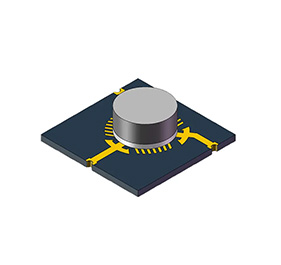
An RF circulator is a non-reciprocal three-port passive device that forces the signal flow in a specific rotational direction (e.g., Port 1 to Port 2, Port 2 to Port 3, and Port 3 to Port 1). This principle is fundamentally based on the interaction of the electromagnetic wave with a magnetically biased ferrite material, a phenomenon known as the Faraday Rotation effect. In a practical Miniature SMT RF Circulator, this effect is maximized by carefully designed microstrip lines coupled to a ferrite puck placed within a static magnetic field.
The defining characteristic of an SMT Circulator is its non-reciprocal nature, which allows it to isolate the transmitter path from the receiver path, even when both share the same antenna. This protection is vital. Without effective isolation, the high-power signal from the transmitter would overload or potentially destroy the low-noise amplifier (LNA) in the receiver. The miniature design achieves this without sacrificing crucial performance metrics.
Critical Performance Metrics of High-Performance Circulators
When selecting a High-Performance Circulator, especially in Surface Mount Technology form factors, engineers must prioritize three key specifications. The miniaturization process significantly complicates the task of maintaining these parameters, underscoring the engineering sophistication required for a robust Miniature RF Circulator design:
| Feature | SMT Circulator | Traditional Drop-In Circulator |
|---|---|---|
| Size and Footprint | Extremely compact (e.g., $3 \times 3 \text{ mm}^2$); ideal for miniaturization. | Larger, bulky design; requires mechanical mounting. |
| Manufacturing | Fully compatible with automated pick-and-place and reflow soldering processes. | Manual assembly, leading to higher labor costs and potential variability. |
| Repeatability | High consistency due to tight process control in PCB mounting. | Slightly more prone to installation variation affecting performance. |
| Cost (Volume) | Lower per-unit cost in high-volume manufacturing due to automation. | Higher integration cost due to manual steps. |
The ability of the Miniature SMT RF Circulator to be seamlessly integrated into high-speed PCB assembly lines is its single largest commercial advantage. This compatibility is non-negotiable for manufacturers aiming to scale production while maintaining the rigorous performance required by 5G RF Components.
Furthermore, the short electrical paths inherent in the SMT design contribute to superior high-frequency performance, pushing operating limits into the Ka-band and beyond, which is essential for future satellite communication links.
SMT Circulators in 5G and Beyond
The deployment of 5G New Radio (NR) utilizes higher frequency bands (mmWave) and requires Massive MIMO (Multiple-Input Multiple-Output) antenna arrays. Each Tx/Rx chain in these complex arrays requires an efficient duplexing solution, making the Miniature RF Circulator a critical enabler of the entire infrastructure. The increased density of components within a 5G small cell demands the absolute smallest possible footprint for every component, ensuring the need for a Small Size, Large Performance component like the high-power SMT Circulator will only grow.
Future development in ferrite components focuses on:
- Increasing the frequency range while maintaining high isolation.
- Improving the power handling capability of smaller packages.
- Developing materials with flatter temperature coefficient performance.
- Further reducing the insertion loss for energy efficiency.
These technological drivers are aimed at solidifying the role of the Miniature SMT RF Circulator as the cornerstone of advanced wireless communication front-ends, from automotive radar to advanced 5G RF Components.
Summary and Outlook
The transition to Miniature SMT RF Circulators marks a significant engineering milestone. By masterfully combining advanced ferrite components with automated Surface Mount Technology, these devices deliver exceptional Isolation and minimal Insertion Loss within an extremely small package. Their integration is not just a trend but a technical necessity for the mass-market deployment of high-frequency and high-data-rate wireless systems, including 5G. As designers continue to push the limits of compact system architecture, the high-performance, Small Size, Large Performance nature of the SMT Circulator will remain vital to protecting sensitive electronics and maximizing system efficiency.
FAQ
What is the main function of an RF Circulator in a transceiver system?
The primary function of an RF Circulator is to act as a non-reciprocal component that directs signal flow, isolating the high-power transmitter (Tx) from the sensitive receiver (Rx) while allowing both to share a single antenna. This prevents damage to the LNA and maintains system integrity.
Why are Miniature SMT Circulators preferred over traditional designs?
Miniature SMT Circulators are preferred because they are compatible with automated pick-and-place manufacturing (Surface Mount Technology), offer a drastically smaller footprint essential for 5G and mobile devices, and often exhibit superior high-frequency performance due to shorter signal paths.
What is the technical trade-off in designing a High-Performance Circulator?
The key technical trade-off is often between achieving high Isolation and maintaining low Insertion Loss. Increasing the magnetic bias or adjusting the ferrite material to boost isolation can sometimes slightly increase the insertion loss, requiring careful optimization for specific application requirements.
References
- Pozar, David M. (2012). *Microwave Engineering, 4th Edition*. Wiley. (Detailed discussion on non-reciprocal components and ferrite devices).
- Bahl, Inder J. (2014). *Lumped Elements for RF and Microwave Circuits*. Artech House.
- Materials Science and Engineering for Ferrite and Magnetic Composites in High-Frequency Applications. *IEEE Transactions on Magnetics*.
- Technical white papers from leading Miniature SMT RF Circulator manufacturers (e.g., Skyworks, TDK) on 5G RF Components integration.
Relateds



About the Author

HzBeat Editorial Content Team
Marketing Director, Chengdu Hertz Electronic Technology Co., Ltd. (Hzbeat)
Keith has over 18 years in the RF components industry, focusing on the intersection of technology, healthcare applications, and global market trends.