Are Magnet-Free Circulators the Future of RF Systems?
Explore whether magnet-free circulators can reshape the future of RF systems. Learn how magnetic-free non-reciprocity supports full-duplex radios, integrated RF front ends, and next-generation wireless architectures.
 Updated on: Mar 17, 2026
 Author:
Introduction
For decades, the RF circulator has been one of the quiet workhorses of microwave engineering. It sits between the transmitter, the antenna, and the receiver, directing energy in one preferred rotation while protecting sensitive receive paths from high-power transmit leakage. In radar, satellite links, test systems, and many high-reliability microwave platforms, the traditional ferrite circulator remains deeply trusted because it is mature, robust, and proven in real hardware.
But RF systems are changing. Wireless hardware is becoming smaller, denser, more integrated, and more software-defined. Engineers now want antenna interfaces that can live closer to the chip, support reconfigurable front ends, and fit into compact radios where size, weight, and integration matter as much as raw microwave performance. That is exactly why magnet-free circulators have drawn so much attention.
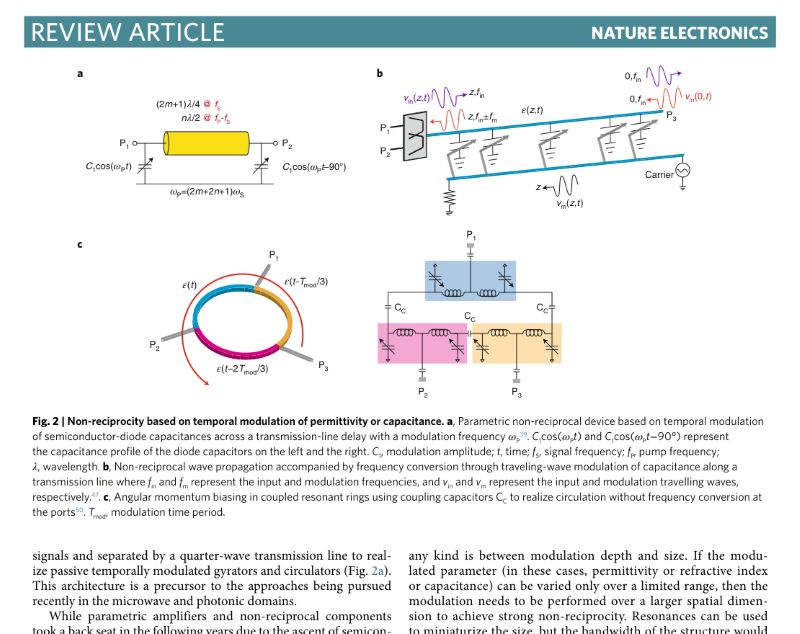
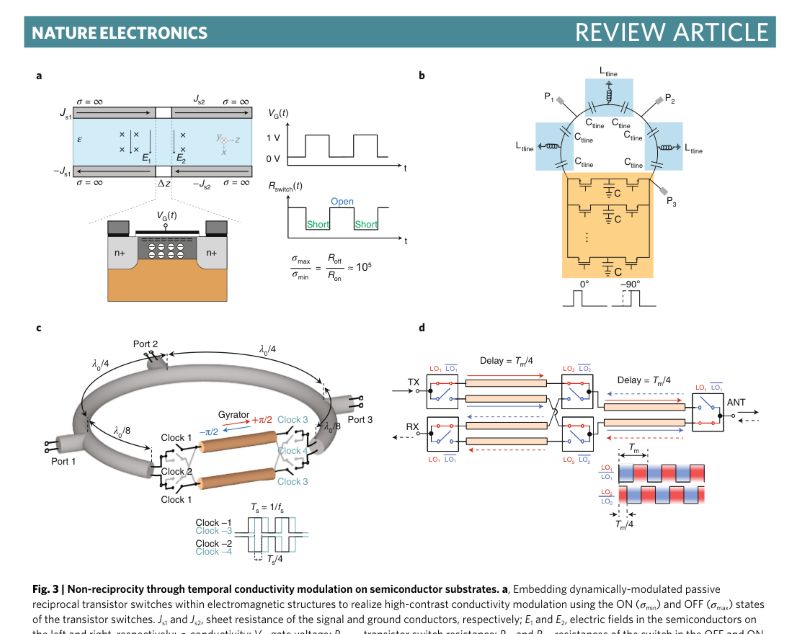
Instead of relying on ferrite materials and magnetic bias, magnet-free circulators generate non-reciprocal behavior through time-varying modulation, staggered commutation, conductivity modulation, or related techniques. Landmark work from Columbia and collaborators demonstrated magnetic-free passive non-reciprocity and highly miniaturized RF circulation, while later research showed broadband and integrated CMOS implementations at millimeter-wave frequencies.
What Is a Magnet-Free Circulator?
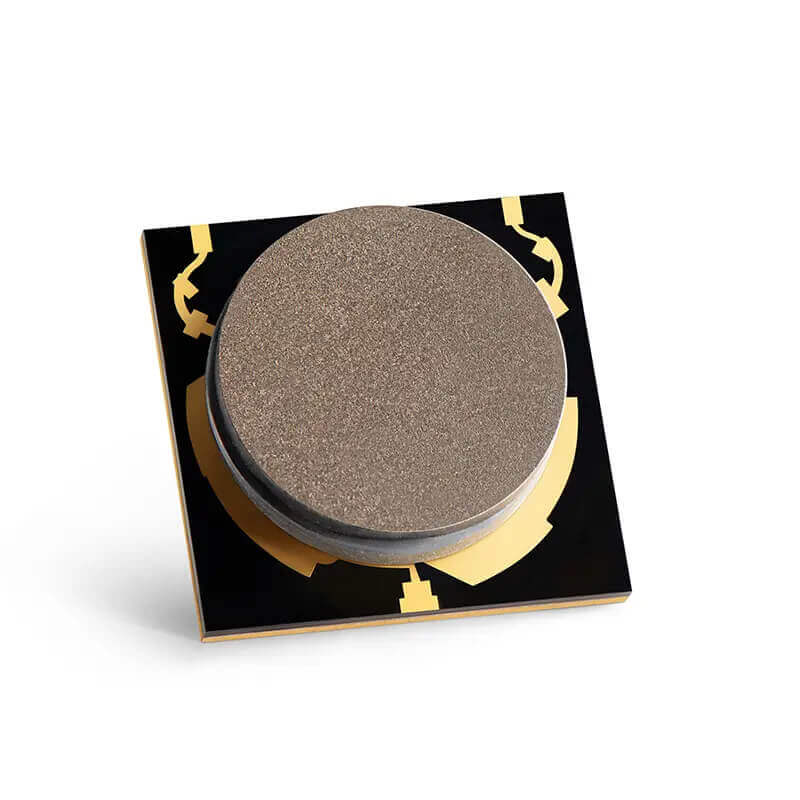
A traditional RF circulator uses ferrite materials under magnetic bias to create non-reciprocity. In simple terms, it makes signals prefer one direction of travel among its ports. A magnet-free circulator seeks the same end result without permanent magnets or external magnetic bias.
That does not make the problem simple. It changes the engineering trick. Instead of using magnetized ferrites, magnet-free architectures usually exploit time variation. Parameters such as conductivity, capacitance, or switching states are modulated in a synchronized way so that forward and reverse propagation no longer experience the same network. Once reciprocity is broken, circulation becomes possible.
Why RF Engineers Care About Magnet-Free Circulators
1. Full-duplex wireless pushes the demand
In a full-duplex radio, the transmitter and receiver operate at the same time on the same frequency. That sounds elegant and brutal at once, because the transmitted signal is often dramatically stronger than the received one. A non-reciprocal antenna interface such as a circulator provides the first layer of isolation before analog and digital self-interference cancellation take over.
2. Integration is the real battlefield
Ferrite circulators still perform extremely well, but they are not naturally friendly to standard CMOS integration. Magnet-free approaches open the door to compact antenna interfaces implemented much closer to the RFIC. That matters in modern radios, especially where board area, module thickness, and front-end complexity are all under pressure.
3. Reconfigurable RF systems reward non-magnetic approaches
Many next-generation RF systems are expected to be more adaptive than their predecessors. Temporal modulation-based non-reciprocal electronics are attractive because they can, in principle, offer reconfigurable behavior that aligns well with future integrated wireless architectures.
How Magnet-Free Circulators Work
At the heart of the concept is a simple but powerful idea: make the network change with time. In a conventional linear time-invariant passive network, propagation from Port A to Port B is typically the same as propagation from Port B to Port A. That symmetry is reciprocity. A circulator needs asymmetry.
Magnet-free architectures create that asymmetry using controlled time variation. In the staggered commutation approach, synchronized switching can emulate a phase-nonreciprocal element and embed it into a resonant structure to realize circulation. In synchronized conductivity modulation, time-varying conductivity is used to enable compact and broadband non-reciprocity, including integrated millimeter-wave circulation in CMOS.
Where Magnet-Free Circulators Clearly Win
- Integration potential: This is the banner headline. Magnet-free circulators fit more naturally into chip-scale or module-scale front ends.
- Compactness: Removing the dependence on bulky magnetic bias structures can support smaller implementations.
- System-level compatibility with full-duplex: In modern front ends, the circulator is not a lonely three-port block. It becomes part of a broader interference-management strategy.
- Architectural flexibility: Non-magnetic approaches pair well with programmable and reconfigurable RF ideas.
Why They Have Not Replaced Ferrite Circulators
Here the marketing fog has to clear. First, power handling remains a major dividing line. Review literature notes that microwave magnetic isolators and circulators can handle tens to hundreds of watts, while the best time-modulated non-magnetic implementations discussed in that review were on the order of a few watts. That already tells a story: for handheld and integrated wireless platforms, magnet-free parts can be relevant; for high-power defence and base-station-class systems, ferrite hardware remains difficult to dislodge.
Second, loss, linearity, noise, and spurious behavior do not disappear for free. The same switching and modulation tricks that break reciprocity can also bring clock feedthrough, implementation complexity, and practical tradeoffs.
Third, manufacturing maturity still matters. Ferrite circulators have spent decades earning trust in production environments. Magnet-free circulators are advancing fast, but a celebrated paper and a long-lived catalog product are not the same species.
Applications Most Likely to Adopt Magnet-Free Circulators First
The most likely early winners are highly integrated wireless front ends, especially those pursuing single-antenna full-duplex operation. That is where the strengths of magnet-free circulators line up most clearly with system requirements: compactness, integration, and non-reciprocal antenna interfacing.
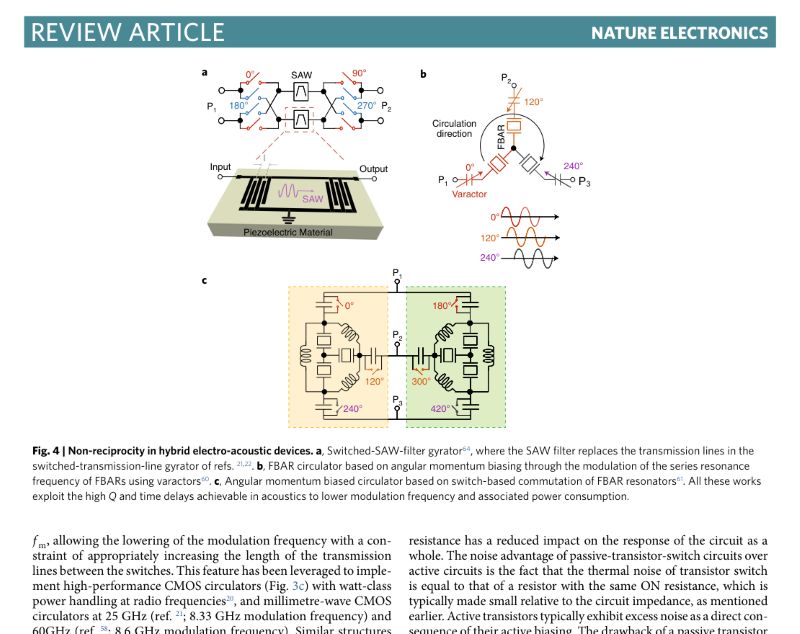
Another strong area is simultaneous transmit-and-receive radar and related sensing systems, where temporal-modulation-based non-reciprocal electronics are already seen as strategically important in the review literature. Hybrid acoustic-electronic approaches such as SAW and FBAR-based concepts show how researchers are also trying to lower modulation frequency and shrink implementation overhead.
By contrast, in traditional high-power radar, satellite payloads, and harsh-environment microwave platforms, ferrite circulators are likely to remain highly relevant for the foreseeable future.
So, Are Magnet-Free Circulators the Future of RF Systems?
The best answer is: they are part of the future, but not the whole future.
If the discussion is about next-generation integrated RF systems, the answer leans strongly toward yes. The research record shows that magnet-free non-reciprocity is no longer a speculative curiosity. It is a serious design direction with proven demonstrations and strong relevance to full-duplex wireless, compact RF front ends, and reconfigurable architectures.
If the discussion is about all RF systems, the answer is more restrained. Ferrite circulators still dominate many applications because they solve hard problems with a degree of maturity that new approaches have not universally matched. The future of RF systems is therefore likely to be hybrid rather than monolithic: magnet-free circulators rising in integrated platforms, ferrite circulators remaining essential in high-power and high-reliability environments.
Conclusion
Magnet-free circulators represent one of the most important shifts in modern RF non-reciprocal design. They answer a real need created by full-duplex communication, RFIC integration, and the push toward smaller, smarter, and more flexible front ends. Foundational papers have already shown magnetic-free passive non-reciprocity, broadband conductivity-modulated non-reciprocity, and integrated CMOS circulation at millimeter-wave frequencies.
But the field is still a story of fit, not universal replacement. In integrated RF systems, magnet-free circulators may well become foundational. In high-power, field-proven microwave systems, ferrite circulators are not stepping off the stage quietly. The future is less a coup and more a coexistence.
FAQ
What is the main difference between a magnet-free circulator and a ferrite circulator?
A ferrite circulator uses magnetic bias and ferrite materials to create non-reciprocity, while a magnet-free circulator typically uses temporal modulation, synchronized switching, or conductivity modulation to achieve directional behavior without magnets.
Are magnet-free circulators already used in practical RF systems?
They are beyond pure theory and have been experimentally demonstrated in integrated RF and CMOS-oriented forms, especially in research connected to full-duplex wireless and compact front ends.
Will magnet-free circulators replace ferrite circulators completely?
Current evidence does not support such a blanket statement. They are more likely to grow first in integrated and reconfigurable RF systems, while ferrite circulators remain strong in high-power and high-reliability applications.
Why are magnet-free circulators important for full-duplex radios?
Because full-duplex systems need antenna interfaces that provide isolation between simultaneous transmit and receive paths, and integrated non-reciprocal interfaces are a major enabler in that architecture.
Is temporal modulation the key enabling technique?
It is one of the most important enabling families of techniques in the literature, especially in reviews of non-magnetic non-reciprocal electronics.
References
- Reiskarimian, N., Krishnaswamy, H. Magnetic-free non-reciprocity based on staggered commutation. Nature Communications, 2016.
- Dinc, T. et al. Synchronized conductivity modulation to realize broadband lossless magnetic-free non-reciprocity. Nature Communications, 2017.
- Nagulu, A., Reiskarimian, N., Krishnaswamy, H. Non-reciprocal electronics based on temporal modulation. Nature Electronics, 2020.
- Nagulu, A. et al. A Review of Integrated Circuits, Systems, and Networks for Full Duplex. Proceedings of the IEEE, 2024.
Recommended Products
 Article Tags
Sara
Sara is a Brand Specialist at Hzbeat, focusing on RF & microwave industry communications. She transforms complex technologies into accessible insights, helping global readers understand the value of circulators, isolators, and other key components.