Can Radar Systems Work Without RF Circulators?
Can radar systems work without RF circulators? Learn when radar can operate without a circulator, what alternatives exist, and why RF circulators still matter in modern radar front ends.
 Updated on: Mar 12, 2026
 Author:
In radar engineering, the phrase “without RF circulators” sounds simple until you trace the signal flow. A transmitter may launch kilowatts or more in pulse power, while the receiver a moment later must detect echoes so weak they would look almost imaginary beside the transmit burst. One shared antenna. Two radically different power levels. Zero tolerance for careless leakage. That is why the RF circulator has remained one of the quiet workhorses of radar front ends.
Introduction:The Question Sounds Smaller Than It Really Is
At a purely functional level, the answer is yes: a radar can operate without an RF circulator. It can still generate RF power, radiate through an antenna, and receive reflected energy from a target. But real radar design is not judged by existence alone. It is judged by whether the transmitter and receiver can safely share hardware, whether the front end stays compact, whether echo sensitivity remains high, and whether the receiver survives repeated exposure to strong transmit energy and antenna mismatch.
That is where the RF circulator matters. Radar references continue to describe ferrite circulators as a practical duplexing element in radar sets, especially where one antenna must serve both transmit and receive functions. Analog Devices, discussing phased-array T/R modules, notes that the module typically contains a power amplifier for transmit, a low-noise amplifier for receive, and either a circulator or a switch to control the direction of RF energy. In other words, the circulator is not the only possible solution—but its job can never simply be wished away.
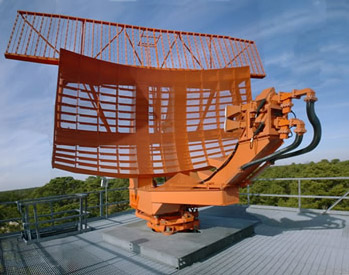
Why RF Circulators Matter in Radar Front Ends
An RF circulator is a non-reciprocal multiport device, usually a three-port ferrite component in radar applications, that routes energy in one direction around the network. In the classic radar arrangement, transmit power enters one port, exits toward the antenna through the next port, and echoes returning from the antenna are directed toward the receiver through the third port. That directional routing is elegant because it solves several system problems at once.
Shared-Antenna Duplexing
A circulator lets the transmitter and receiver use a common antenna path without physically moving parts. That is valuable in compact radar heads, phased-array modules, and systems where antenna count and feed complexity must stay under control.
Receiver Protection
A sensitive LNA chain does not enjoy being hit by a transmit pulse. A circulator helps keep forward power and reflected energy from taking the scenic route straight into the receiver.
Lower RF Routing Complexity
Using a passive ferrite device can simplify timing and control compared with a more elaborate switch-and-limiter arrangement, especially in systems where insertion loss and recovery behavior are tightly constrained.
System-Level Efficiency
Every extra component in the RF path adds loss, risk, and integration burden. A good circulator often solves more than one problem with less drama than the alternatives.
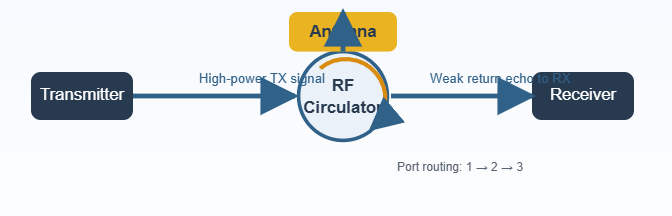
Can Radar Systems Work Without RF Circulators?
Yes. But the missing phrase is “under a different isolation strategy.” A radar without an RF circulator is not impossible. It is simply a radar that must solve the front-end separation problem another way. There are several ways that can happen:
- T/R switches: a switch connects the antenna to the transmitter during the transmit interval and then reconnects it to the receiver for the listening interval.
- Separate transmit and receive antennas: the architecture avoids a shared antenna path altogether.
- Alternative duplexing structures: depending on band and platform, designers may rely on switches, hybrid networks, waveguide structures, or specialized front-end assemblies.
- Application-specific frequency separation: useful in some systems, but not a universal replacement where same-frequency directional routing is required.
That distinction matters because people sometimes ask the question in the wrong tone. They ask whether radar can be built without a circulator as if removing one part somehow removes the underlying problem. It does not. Physics does not take early retirement because a bill of materials got shorter.
What Replaces the RF Circulator?
1. T/R Switches
Switch-based front ends are real, common, and sometimes preferable. In phased-array and module-level design, a T/R module may use either a circulator or a switch to control RF direction. Switches can be attractive where timing is deterministic, solid-state integration is preferred, or the architecture already includes limiter-assisted protection in the receive chain.
But switch-based solutions introduce their own obligations. The switch must handle power, survive hot switching conditions if relevant, recover quickly, maintain isolation, and avoid turning the receive path into a slightly more expensive apology letter. In pulsed radar, switch timing and recovery can become critical.
2. Separate Transmit and Receive Antennas
This avoids shared-port duplexing entirely. The transmitter uses one antenna, the receiver another. That can work well in large platforms or application-specific radars, but it increases physical footprint and system integration burden. More feed networks, more alignment concerns, more platform space, more coupling management. Engineers do not get that for free.
3. Specialized Duplexer Structures
Radar literature and industry references continue to distinguish duplexers from diplexers. A duplexer separates transmit and receive paths based on direction and can support same-frequency operation, while a diplexer separates by frequency. That difference is important. A diplexer is not a drop-in substitute for a same-frequency radar duplexing problem. The choice depends on architecture, band plan, and system goals.
| Isolation Method | How It Works | Main Advantages | Main Trade-Offs | Typical Fit |
|---|---|---|---|---|
| RF Circulator | Routes power directionally between TX, antenna, and RX. | Compact shared-antenna duplexing, passive operation, strong fit for radar front ends. | Ferrite biasing, frequency-specific design, cost depends on band and power level. | Pulse radar, phased array, compact shared-antenna systems |
| T/R Switch | Switches antenna path between transmit and receive states. | Solid-state control, flexible integration, widely used in modules. | Timing, isolation, insertion loss, power handling, limiter coordination. | Phased-array modules, pulsed systems, integrated RFIC-heavy designs |
| Separate Antennas | Uses dedicated TX and RX antennas instead of a shared port. | Simplifies some T/R isolation requirements. | Larger system size, alignment burden, more hardware and feed paths. | Large platforms, special-purpose radar layouts |
| Frequency-Separated Network | Splits paths using different frequency regions and filtering structures. | Useful when TX and RX are frequency-separated by design. | Not a universal replacement for same-frequency directional duplexing. | Application-specific architectures |
Why RF Circulators Are Still Preferred in Many Radar Systems
If alternatives exist, why does the RF circulator still show up so often in radar block diagrams, data sheets, and system discussions?
Because radar front ends are unforgiving. Designers fight hard for every tenth of a decibel of insertion loss, every margin improvement in isolation, and every degree of confidence that the receiver will not be overdriven by its own transmitter. A circulator often remains attractive because it provides a compact, well-understood, and system-efficient answer to that challenge.
Radar Tutorial still describes ferrite circulators as being used as duplexers in radar sets, and industry sources continue to frame circulators and isolators as devices that help protect sensitive receiver circuitry and support shared-antenna operation. For phased arrays and rugged high-reliability systems, recent industry reporting still highlights circulators in radar, EW, and communication applications where insertion loss, isolation, and reliability matter.
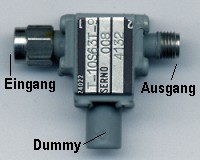
The Real Trade-Off: Removing the Circulator Rarely Removes the Cost
That is the heart of the engineering answer. A circulator is not sacred. It is practical. Remove it, and another part of the design must absorb the cost:
- Insertion loss cost: more RF blocks often means more loss.
- Control cost: switches require timing logic and state control.
- Protection cost: limiters and receiver-hardening measures may need to become more aggressive.
- Mechanical cost: separate antennas consume space.
- Integration cost: more parts mean more testing, more failure modes, and more system tuning.
In other words, the debate is not circulator or no problem. It is circulator or a different set of compromises. Engineers understand that instinctively. Procurement teams sometimes discover it a little later—usually after the first "cost-down" meeting starts behaving like an unintended RF comedy sketch.
How This Connects to Product Selection in Real Radar Projects
In practical procurement and design work, the right question is not simply whether the radar uses a circulator, but what kind of circulator topology best matches the radar front end. Waveguide structures are often chosen when very high power, low loss, and rugged mechanical performance matter. Coaxial and drop-in formats can fit module and subsystem integration paths. Microstrip and SMT styles make sense when compactness and integration density dominate the decision.
For radar-oriented projects, that means the selection flow should usually consider:
- Frequency band and usable bandwidth
- Insertion loss and the receive sensitivity budget
- Isolation needed between TX and RX paths
- Peak and CW power handling
- Package style for the antenna feed and module layout
- Thermal and environmental demands
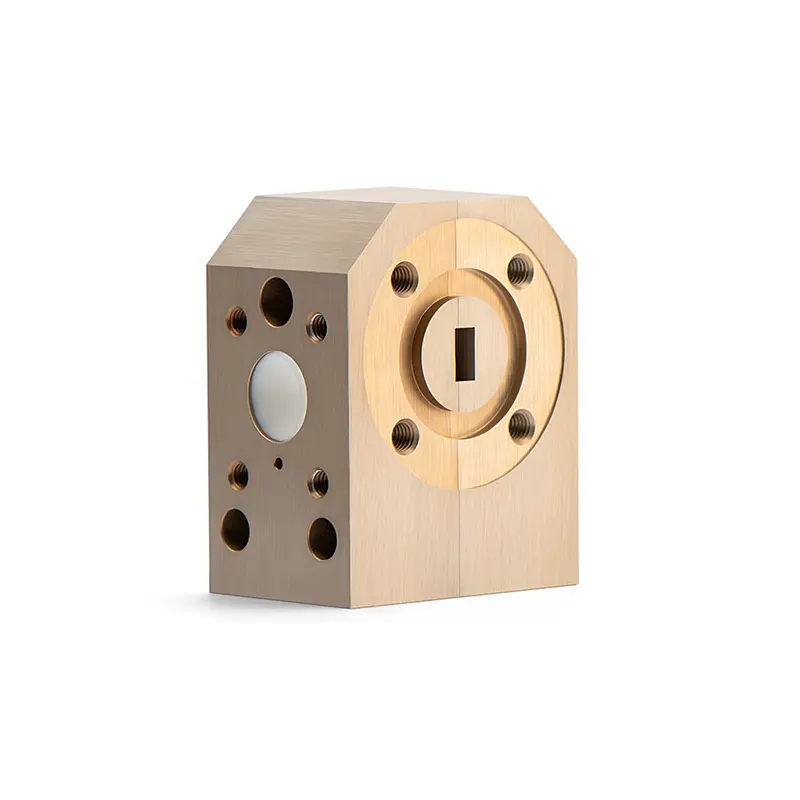
RF Circulators, Waveguide Circulators, Junction Waveguide Circulator, Custom RF Circulators for Radar, SatCom, and 5G Modules.
| Radar Design Priority | What It Usually Means for the RF Front End | Circulator Relevance |
|---|---|---|
| Lowest possible path loss | Every added device affects link budget and receiver sensitivity. | Circulators remain attractive because they can provide directional routing with low practical overhead. |
| Compact shared-antenna structure | One antenna must support both transmit and receive. | Strong reason to keep a circulator or equivalent duplexing function in play. |
| Highly integrated T/R module | Switch-based architectures may be preferred for semiconductor integration. | Circulator may compete with T/R switches depending on power, loss, and module strategy. |
| Very high power waveguide path | Mechanical robustness and power handling rise to the top. | Waveguide circulators are often favored. |
| Cost-down redesign | Teams try to reduce BOM or simplify sourcing. | Removing the circulator may shift cost elsewhere rather than truly eliminating it. |
Conclusion
So, can radar systems work without RF circulators? Yes. But they cannot work without some alternative strategy for transmit/receive isolation, receiver protection, and shared-antenna management if a shared antenna is still required.
That is why RF circulators continue to matter in radar. They offer a practical, compact, and proven answer to a problem that never really goes away. Switches, separate antennas, and other duplexing structures can replace them in some designs, but every replacement comes with trade-offs in loss, complexity, control, size, or robustness. The circulator survives not because engineers are sentimental, but because the job it performs is still brutally relevant.
For radar developers, system integrators, and buyers, the best decision is usually not to ask whether a circulator is fashionable. It is to ask what the radar front end must achieve, what penalties are acceptable, and which topology delivers the cleanest RF path under real-world power and packaging constraints.
FAQ
1. Is an RF circulator mandatory in every radar system?
No. A radar can be designed without an RF circulator, but it still needs another method for transmit/receive separation and receiver protection.
2. Can a T/R switch replace a radar circulator?
Yes, in many architectures. In fact, T/R modules may use either a circulator or a switch. The choice depends on power, insertion loss, integration style, timing, and protection requirements.
3. Why do shared-antenna radar systems often prefer RF circulators?
Because they help route energy directionally between transmitter, antenna, and receiver in a compact way, reducing the burden on the rest of the RF chain.
4. Can a diplexer replace a duplexer or circulator in radar?
Not in the general case. A diplexer separates paths by frequency, while a duplexer or circulator is used when directional transmit/receive management is needed, including same-frequency use cases.
5. Which circulator type is more common in radar hardware?
That depends on band, power level, and integration method. Waveguide circulators are common in higher-power radar paths, while drop-in, coaxial, and microstrip formats may be better suited to subsystem or module-level integration.
References
- Radar Tutorial, Duplexer.
- Radar Tutorial, Ferrite Circulators.
- Radar Tutorial, Dual Polarization Radar.
- Analog Devices, An Interview with Analog Devices Discussing RF Electronics for Phased Array Applications.
- Pasternack, What are RF Isolators and RF Circulators?.
- Pasternack, What’s the Difference Between a Diplexer and a Duplexer?.
- everything RF, Surface-Mount RF Circulators for Radar, EW, and Communication Systems.
- HzBeat, Waveguide Circulator.
- HzBeat, Junction Waveguide Circulator.
- HzBeat, Custom RF Circulators for Radar, SatCom, and 5G Modules.
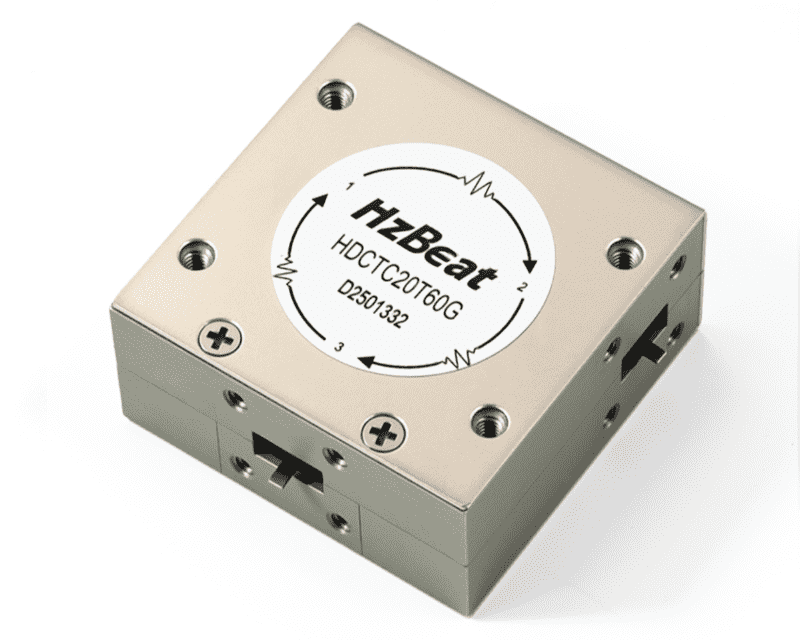
Recommended Products
.jpg)
 Article Tags
Keith Wong
Marketing Director, Chengdu Hertz Electronic Technology Co., Ltd. (Hzbeat)
Keith has over 18 years in the RF components industry, focusing on the intersection of technology, healthcare applications, and global market trends.