The Importance of RF Circulators in C-Band 5G Deployment
Explore why RF circulators are important in C-Band 5G deployment, helping improve signal routing, isolation, and front-end stability in AAU, small cell, and FWA systems.
 Updated on: Mar 17, 2026
 Author:
C-Band remains the strategic middle ground of modern 5G rollout. But spectrum alone does not make a radio network perform. In real hardware, RF circulators help preserve signal directionality, improve isolation, and protect front-end chains that must stay stable under dense traffic, reflected power, and demanding thermal conditions.
Introduction
C-Band, commonly centered on the 3.3–4.2 GHz range and especially the 3.5 GHz ecosystem, is widely regarded as the most practical spectrum layer for mainstream 5G deployment. It offers what operators, equipment vendors, and infrastructure planners all want but rarely get at the same time: meaningful bandwidth, workable coverage, acceptable penetration, and scalable economics. That is why policy discussions, auctions, radio planning, and network modernization programs keep circling back to the same conclusion: if 5G is going to move from coverage claims to sustained capacity, mid-band has to carry much of the load.
That bigger story is now well known. What is easier to miss is the hardware reality underneath it. A C-Band license does not automatically produce a robust C-Band network. Once spectrum policy becomes actual radio equipment, engineers still have to deal with transmit power, mismatch, thermal load, antenna integration, signal leakage, front-end linearity, and long-term reliability. This is where RF circulators stop being invisible parts and start becoming practical system enablers.
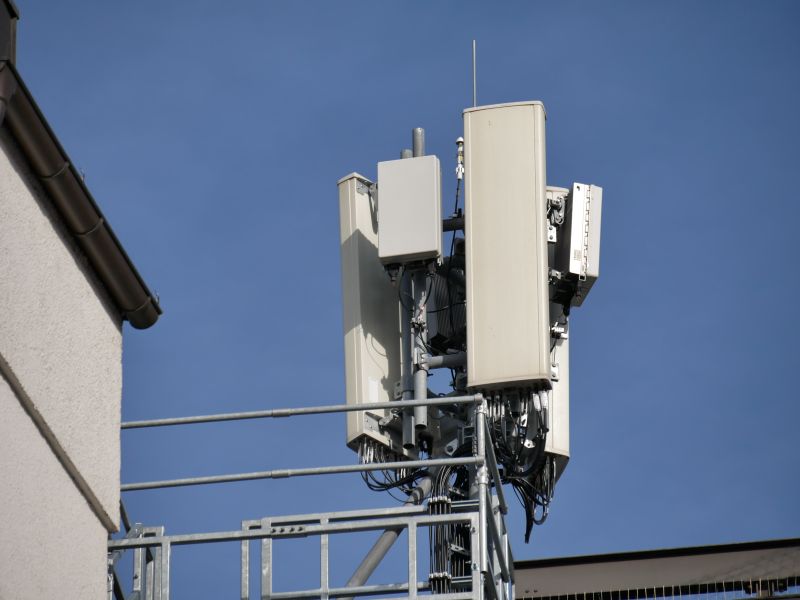
In C-Band 5G radios, especially in active antenna units, macro radio heads, compact outdoor nodes, and fixed wireless access equipment, RF circulators help maintain directional signal flow and support stable RF behavior under real operating stress. They are not the headline act, but they are part of the reason the headline act stays on stage. A network can have wide channels and advanced beamforming, yet still suffer if the front-end chain is noisy, lossy, mismatch-sensitive, or thermally fragile.
Why C-Band Became the Core 5G Deployment Band
There is a reason engineers and regulators keep calling 3.3–3.8 GHz the pioneer 5G band. Low-band spectrum reaches far, but bandwidth is limited. mmWave can deliver spectacular peak throughput, but propagation and deployment cost make it difficult to use as the broad national workhorse. C-Band sits in the middle and behaves like the adult in the room: less dramatic, more useful, and much easier to scale in dense real networks.
GSMA has repeatedly identified 3.5 GHz as the pioneer 5G band, and the band has seen broad harmonization progress in multiple regions. In the United States, the scale of the FCC's C-Band Auction 107 underlined the strategic importance of mid-band spectrum to operators, with gross bids exceeding USD 81 billion. The business message was clear: the industry was willing to spend heavily because C-Band is where 5G performance and practical coverage can actually meet. Meanwhile, Ericsson's 2025 mobility outlook projected that 5G networks would carry an overwhelming share of global mobile traffic by 2030, which further raises the importance of stable and efficient mid-band radio infrastructure.
From a radio engineering perspective, C-Band helps unlock several benefits at once. It supports wider channels than legacy low-band holdings, making it suitable for high-capacity 5G NR deployments. It offers more manageable propagation characteristics than high-band spectrum, which improves site economics and reduces how aggressively operators must densify. It also fits well with massive MIMO and beamforming architectures that depend on sophisticated antenna and radio integration to translate spectrum assets into actual user experience.
That combination makes C-Band central not only to macro public networks but also to enterprise private wireless, transportation corridors, dense city deployments, and FWA access expansion. In other words, C-Band is not merely important because of its frequency range. It is important because it has become the operational center of gravity for real 5G rollout.
| Band Layer | Typical Strength | Main Limitation | Deployment Role |
|---|---|---|---|
| Low Band | Wide-area coverage and penetration | Limited bandwidth and lower capacity ceiling | Coverage foundation |
| C-Band / Mid-Band | Balanced coverage, capacity, and economics | Needs disciplined RF front-end integration at scale | Primary 5G performance layer |
| mmWave / High Band | Very high throughput and dense hotspot capacity | Weaker propagation, heavier site density requirements | Hotspot and ultra-high-capacity overlay |
Why RF Circulators Matter in C-Band Radio Architectures
Once a 5G system moves from spectrum planning into hardware implementation, the conversation changes. The question is no longer just which band to deploy. The real question becomes how to make that radio chain behave cleanly, efficiently, and repeatably under field conditions. C-Band radios face reflected power from imperfect loads, leakage between paths, tight insertion-loss budgets, and thermal stress that grows as bandwidth and power rise. That is exactly the environment where RF circulators become useful.
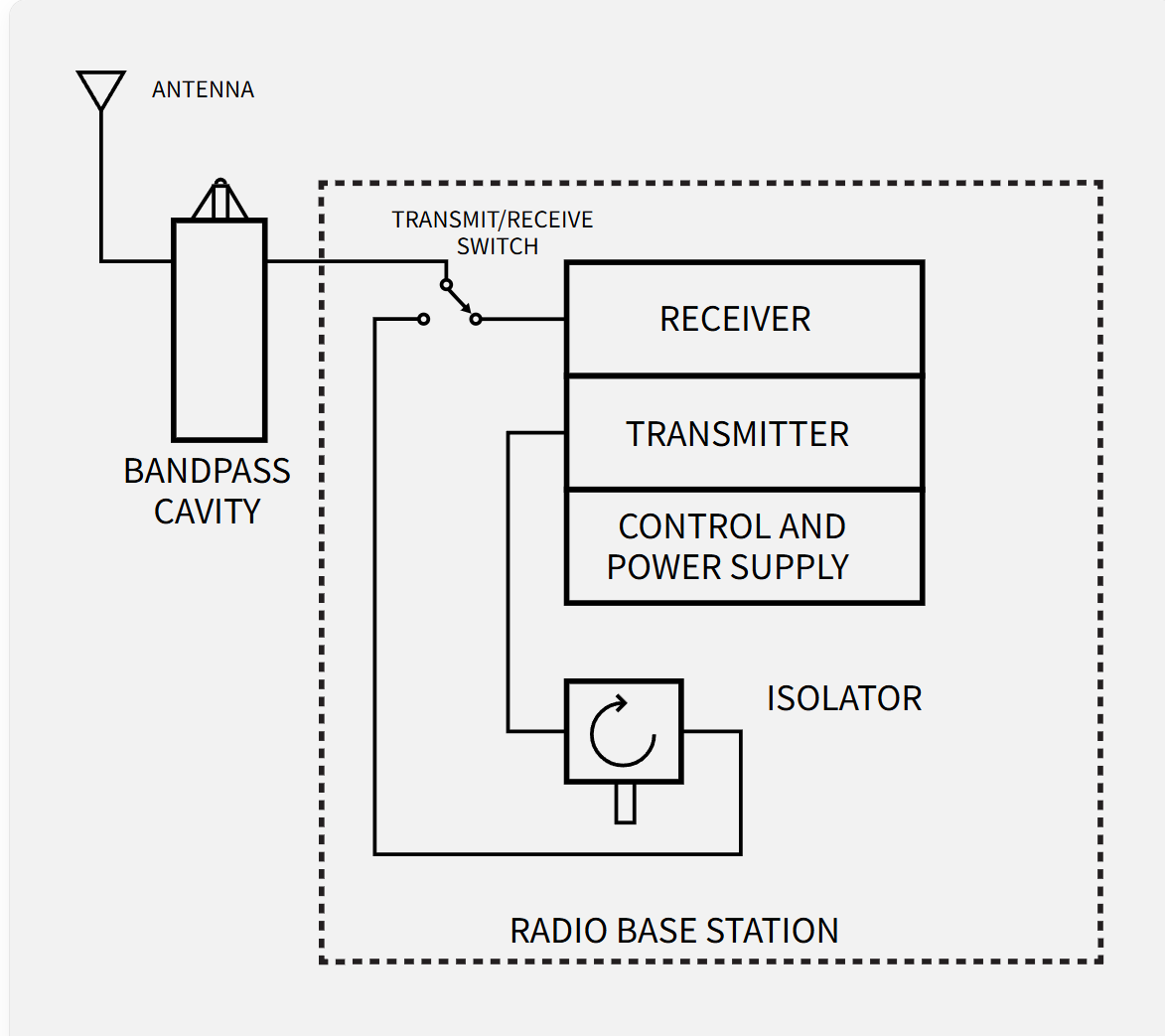
An RF circulator is a non-reciprocal component that routes microwave energy directionally from one port to the next. In practical system language, it helps keep transmit energy going where it should go and helps keep unwanted energy from walking back into places where it can degrade performance. In a base station front-end, that matters for receiver protection, signal integrity, mismatch handling, and overall robustness.
For C-Band 5G in particular, the value of an RF circulator shows up in several ways. First, insertion loss matters. Every fraction of a decibel lost in the front-end erodes effective power budget and can add heat where no one wants extra heat. Second, isolation matters. Leakage into the receive path raises risk for desense, compression, and degraded sensitivity. Third, return conditions matter. Real antennas do not live in a textbook; they live on rooftops, poles, and towers under weather, contamination, mechanical shift, and aging. A well-selected RF circulator helps the radio remain calmer when the outside world is not.
In many front-end chains, circulators are used between the power amplifier and the antenna path, or in related routing positions where directional control and reflected-power management are needed. In isolator-style protection architectures, absorbed reflected energy can help shield active stages from mismatch stress. In circulator-based signal routing, the core point is the same: signal direction is no longer an abstract schematic arrow but a controlled engineering outcome.
Four reasons RF circulators deserve a place in the C-Band conversation
- Directional signal control: They help maintain cleaner transmit-to-antenna-to-receive behavior in RF front-end paths.
- Receiver and amplifier protection: They reduce the impact of unwanted reverse energy and reflected power on sensitive stages.
- Lower system stress: Better handling of mismatch can support improved thermal and long-term operating stability.
- Practical integration value: In compact radio platforms, one stable non-reciprocal device can simplify front-end behavior and reduce headaches elsewhere in the chain.
Where This Matters Most: AAU, Macro, Small Cell, and FWA
AAU and massive MIMO radio units
Active antenna units compress more RF function into less physical space. They combine radio, antenna, and beamforming intelligence in tighter assemblies, which means the tolerance for unnecessary loss and unstable signal behavior becomes smaller. In these systems, RF circulators help support controlled signal routing and front-end consistency, especially where many channels operate together and thermal concentration is already a design concern.
Macro C-Band deployments
At macro sites, operators expect C-Band to deliver wide-area capacity uplift. That puts real pressure on link budget, power efficiency, and receiver cleanliness. A poorly chosen front-end component can quietly eat margin all day long. A well-chosen C-Band RF circulator, on the other hand, helps preserve directional behavior and supports the broader radio objective: stable network KPI performance instead of field surprises.
Dense urban small cells
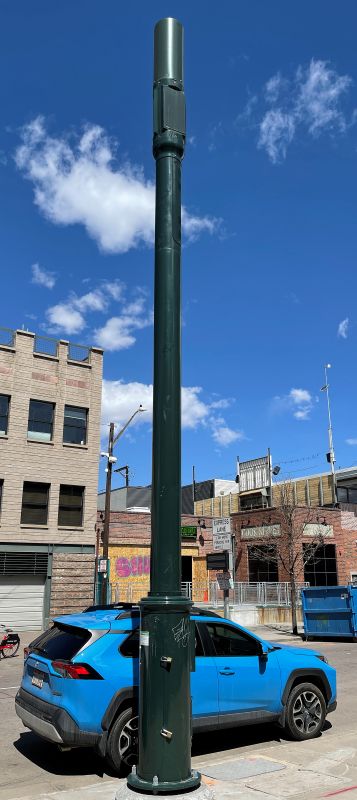
Small-cell and street-level deployments may not carry the same raw power as large macro systems, but they bring their own punishment: tighter enclosures, thermal concentration, denser interference environments, and packaging constraints. Here, compact RF circulator solutions can still play an important role by supporting isolation and signal discipline without demanding oversized mechanical envelopes.
Fixed wireless access equipment
FWA is one of the clearest practical growth stories for 5G because it turns radio capacity into broadband service in places where fiber rollout may be slower, costlier, or less flexible. In FWA hardware, stable front-end design matters because the commercial promise is not just speed marketing; it is reliable day-to-day service. RF circulators can help by supporting controlled RF routing and reducing the negative effects of non-ideal return conditions in compact equipment architectures.
How to Evaluate a C-Band RF Circulator
Choosing a C-Band RF circulator is not just about matching the center frequency and moving on. It is an exercise in system honesty. The right part depends on what the radio is truly facing, not what the datasheet fantasy says it should face.
1. Frequency range and usable bandwidth
Start with the actual operating band and needed margin. A part that technically covers the target band but does so with poor edge behavior can become a silent problem, especially if filters, guard bands, or wide channels push performance close to the limits.
2. Insertion loss
Insertion loss should be treated like rent: you pay it every day. Lower insertion loss preserves valuable RF power, reduces wasted energy, and helps control thermal load. In modern radio design, even tenths of a decibel are worth respect.
3. Isolation
Isolation is where many bad days are avoided before they happen. Strong and stable isolation helps contain leakage into receive paths and supports more predictable front-end operation across temperature and load variation.
4. VSWR and mismatch robustness
Antennas shift. Cables age. Environments change. A practical C-Band circulator must survive real mismatch conditions and continue to behave well enough that the rest of the radio is not dragged into avoidable stress.
5. Power handling and thermal behavior
High-power performance is not just a number in watts. It is a thermal story. Material choice, ferrite behavior, mechanical structure, and heat path all influence whether the part remains stable when deployed continuously in demanding radio hardware.
6. Package and integration fit
Microstrip, drop-in, coaxial, and waveguide structures each solve different problems. For many C-Band 5G applications, compact microstrip and drop-in solutions are attractive because they fit dense integration requirements. But the best package is always the one that matches the actual RF, thermal, and mechanical design target rather than the one that merely looks familiar.
HzBeat C-Band RF Circulator Solutions
For customers working on C-Band and Sub-6 GHz front-end design, the practical challenge is rarely just “find a part at this frequency.” The harder question is how to find a part that fits the actual project balance of size, loss, isolation, power, and integration risk. That is where a focused C-Band RF circulator portfolio becomes more useful than a generic catalog line item.
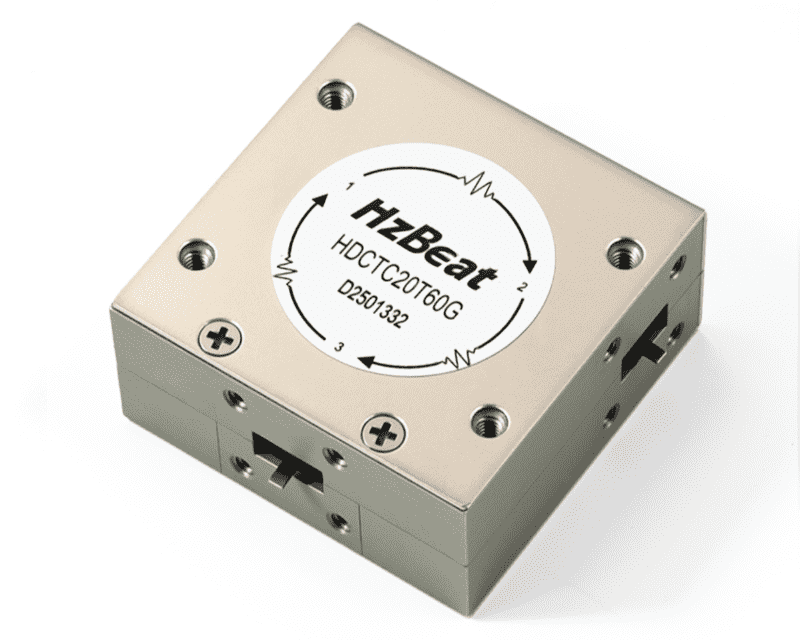
HzBeat provides RF circulator and isolator solutions across multiple structure types, including microstrip, drop-in, coaxial, and waveguide formats. For 5G-oriented RF design, compact microstrip and drop-in configurations are often especially relevant because they align better with dense radio layouts, active antenna units, compact outdoor hardware, and integration-sensitive front-end assemblies. The engineering objective is simple to describe and hard to execute well: low insertion loss, stable isolation, good VSWR behavior, and reliable operation under continuous RF load.
In practical deployment terms, this means helping customers match the component to the real architecture rather than forcing the architecture to work around the component. Some projects care most about footprint. Some care most about ruggedness. Some need a better compromise among bandwidth, thermal headroom, and assembly method. For C-Band 5G systems, where the front-end is often crowded and performance budgets are unforgiving, that matching process matters more than flashy marketing adjectives.
That is also why it makes sense for this article's title to explicitly include RF circulators. C-Band may be the strategic spectrum layer, but RF circulators are part of the quiet hardware layer that helps the spectrum strategy survive contact with physics.
Conclusion
C-Band became central to 5G deployment because it solved a difficult equation better than the alternatives. It offers enough bandwidth to matter, enough propagation to scale, and enough economic practicality to support broad rollout. But the engineering work does not end at spectrum allocation. It begins there.
Once C-Band is turned into actual radio hardware, front-end quality becomes part of network quality. RF circulators contribute to that quality by supporting directional signal routing, reducing unwanted RF stress, and helping radio chains stay stable in the face of real-world mismatch and operating load. They are not the only important component in a C-Band 5G system, but they are absolutely one of the components that deserve a place in the conversation.
That is the real answer to the title. The importance of RF circulators in C-Band 5G deployment is not theoretical. It is practical, architectural, and felt most clearly in the places where system reliability has to stop being a promise and start being a measurable result.
FAQ
Why is C-Band so important for 5G deployment?
C-Band offers the best mainstream balance between coverage, capacity, and deployment cost. It provides more practical large-scale 5G value than low-band alone, while avoiding many of the propagation and densification challenges associated with mmWave.
What does an RF circulator do in a C-Band 5G radio?
An RF circulator routes energy directionally among ports. In C-Band radio hardware, that helps maintain cleaner signal flow, improve isolation, and reduce the harmful effects of reflected power on sensitive RF stages.
Are RF circulators only used in macro base stations?
No. They can also be relevant in active antenna units, compact radio heads, small cells, FWA equipment, and other RF front-end designs where stability, mismatch handling, and signal control matter.
Which parameters matter most when selecting a C-Band circulator?
The most important factors are operating band, insertion loss, isolation, VSWR, power handling, thermal stability, package type, and compatibility with the physical and electrical design of the target system.
References
- GSMA Spectrum, 5G Spectrum Guide.
- GSMA, GSMA hails groundbreaking spectrum decisions at WRC-23.
- FCC, Auction 107: 3.7 GHz Service.
- FCC, FCC Announces Winning Bidders in C-Band Auction.
- Ericsson, June 2025 Ericsson Mobility Report highlights growing monetization appeal of 5G fixed wireless access.
- HzBeat, RF Circulators for 5G Base Stations: Enhancing Signal Integrity & System Reliability.
- Wikimedia Commons, Antennes 5G o2 Munich.jpg.
- Wikimedia Commons, 5G cell tower.JPG.
- Wikimedia Commons, Base station antenna network.svg.
Recommended Products
.jpg)
 Article Tags
Sara
Sara is a Brand Specialist at Hzbeat, focusing on RF & microwave industry communications. She transforms complex technologies into accessible insights, helping global readers understand the value of circulators, isolators, and other key components.