RF Circulators for Satellite Communication
A deep technical article on RF circulators in satellite communication, covering shared-antenna operation, link budget impact, isolation, thermal stability, power handling, and structural trade-offs.
 Updated on: Mar 23, 2026
 Author:
Introduction
Satellite communication is unforgiving to casual design. In spacecraft RF systems, engineers trade antenna size, transmit power, data rate, and mass against one another through link-budget analysis, and the result is usually expressed as a margin in decibels that stands for reliability. NASA’s current spacecraft communications overview also notes that RF space links span roughly 30 MHz to 60 GHz, and that moving to higher frequencies improves gain-to-aperture ratio but also increases atmospheric and rain attenuation as well as free-space loss. In that environment, an RF circulator is not merely a routing accessory; it is one of the components that helps protect system margin from being quietly eroded.
A circulator is a ferrite, non-reciprocal three-port device: power entering Port 1 predominantly exits Port 2, Port 2 exits Port 3, and Port 3 exits Port 1. That simple-looking behavior is exactly why circulators remain relevant in satellite and microwave systems: they make directional control possible without asking the whole front end to become mechanically or electrically bloated.
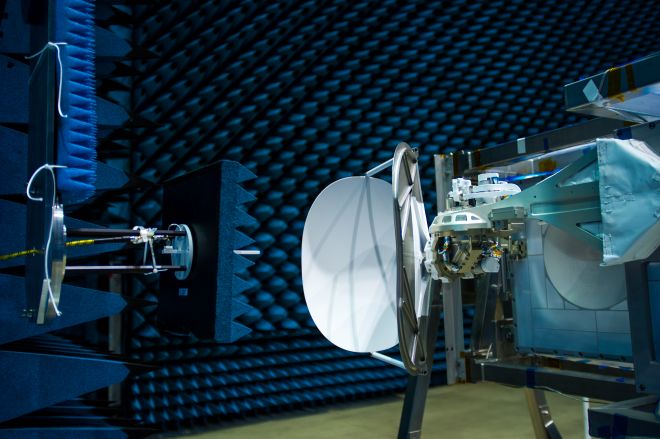
Why circulators appear in satellite RF front ends
In practical transmit/receive architectures, a circulator is used as a duplexing element that allows the antenna to be shared between the transmit and receive paths. Microwaves101 describes the duplexer in a T/R module as the part that lets one antenna serve both TX and RX, and notes that this function can be implemented by a ferrite circulator. That basic function is not limited to theory: ESA’s ERS-2 spacecraft description states that pulses from a 50 W travelling-wave tube passed through front-end electronics made up of circulators and a calibration coupler before reaching the antenna, while return echoes came back through the same front-end chain toward the receiver and LNA.
This matters because satellite systems are allergic to unnecessary duplication. Separate antennas, extra switching hardware, and more mechanical pointing burden all cost mass, volume, control complexity, or insertion loss somewhere else in the chain. A circulator is attractive precisely because it helps solve a system problem with a comparatively elegant passive device. That is why, even in older but still instructive NASA communications architectures, the output of a TWT amplifier was sent via a circulator to the transmit terminal of a common antenna.
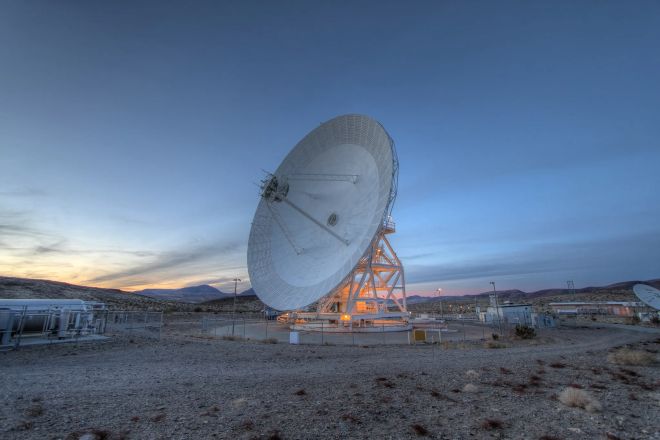
Shared-antenna operation and why isolation is never just a datasheet number
The comfortable way to talk about isolation is to quote a number from a datasheet. The honest way is to admit that system isolation is always worse than the headline if the antenna match is poor, the surrounding chain is imperfect, or the operating condition drifts. Microwaves101’s simultaneous-transmit-and-receive note says a circulator between TX, RX, and antenna can “easily” provide around 20 dB isolation, but also warns that the isolation falls as antenna return loss worsens. In other words, the circulator cannot save a badly behaved antenna from the consequences of being badly behaved.
That point becomes more serious in satellite hardware because isolation is tied to receiver survival and noise performance, not just neat block diagrams. In the T/R module discussion, Microwaves101 notes that when the antenna VSWR becomes ugly, the mismatch can be passed back to the power amplifier, causing load-pull-related degradation; it also notes that an isolator is often inserted so that the antenna and power amplifier see a matched load regardless of what the LNA or limiter are doing. The same page points out that when the LNA is switched off during transmit, it can present a large mismatch, which is one reason isolation and termination strategy matter so much.
So in satellite communication, “high isolation” is not a beauty metric. It is what stands between a shared-antenna architecture and a noisy, unstable front end that starts behaving like two people trying to talk through the same doorway at once—one with a megaphone.
The link-budget view: insertion loss, receiver noise, and real system penalty
The article on satellite communications from NASA’s Small Spacecraft Systems chapter makes the core design logic clear: engineers run link-budget trades over antenna size, RF output power, data rate, atmospheric attenuation, and coding, and each candidate design returns a margin in dB representing reliability. That framework is exactly why circulators deserve more respect than they usually get in marketing copy. A circulator sits directly in the RF path, so its insertion loss taxes the transmit side and the receive side differently but unavoidably.
On transmit, insertion loss reduces the RF power that actually reaches the antenna. On receive, loss before or near the LNA contributes directly to the effective noise performance of the chain. NASA’s communications overview emphasizes the receiver role of the LNA in amplifying weak signals while minimizing thermal noise; older NASA system documentation also remarks that output filtering may ultimately be required after a TWT so that tube noise does not degrade receiver noise figures, with the exact implementation depending in part on the isolation between transmit and receive channels. Taken together, these are not abstract concerns: poor control of loss and leakage can eat margin twice, once in delivered power and once in receive quality.
That is why, from a system viewpoint, a circulator is not just a three-port ferrite junction. It is part of the margin-management strategy. If the link is already tight because of path loss, rain attenuation, or pointing constraints, then a mediocre circulator design quietly becomes a system-level tax collector.
Temperature drift, magnetic bias, and why stability matters in orbit
Here is where the shallow articles usually wave their hands and leave the room. Ferrite circulators are not immune to temperature. A NASA technical report discussing stability of circulator characteristics with regard to temperature and applied field states that it is “of utmost importance” for circulator characteristics to have as little temperature dependence as possible. The same report explicitly says that if temperature changes, the circulator generally changes both its impedance and its frequency response, and further notes that the saturation magnetization of the ferrite normally varies appreciably with temperature.
That is not a trivial lab curiosity. In satellite service, temperature is not polite. Components see cycling, gradients, and long-duration operation where small parameter shifts can accumulate into noticeable RF consequences. Once the ferrite’s magnetic behavior shifts, the circulator’s matching and isolation can shift with it. That means the device can still be “working” while the system around it is becoming less forgiving. It is a slow kind of failure—more treacherous than a dramatic one.
The engineering answer is not simply “pick a good part.” It is compensation, package design, bias stability, materials control, and validation under the temperatures that actually matter. NASA’s millimeter-wave microstrip circulator development report is useful here because it moves from theory into measured hardware: it reports a Ka-band circulator with greater than 16 dB isolation and less than 0.7 dB insertion loss, then states that temperature cycling from -20 °C to +50 °C for three continuous cycles showed no significant impact or variation in performance. That does not mean every microstrip circulator is magically stable; it means temperature stability has to be designed and verified, not assumed.
High-power operation, reflected energy, and isolator behavior
Space RF front ends are often discussed as if they only care about weak-signal purity. In reality, some of them also care about power, sometimes a lot of it. ESA’s High Power Q-Band Isolator project is a sharp example: a compact waveguide isolator was developed to provide full reverse-power protection for TWTAs with 100 W continuous-wave output for next-generation Q-band multi-beam satellite missions. ESA states that the design could handle the full 100 W under full-reflection conditions without overheating the ferrite junction discs, thanks to the Y-junction circulator approach, mixed-metal housing, and thermal design of the load.
That example exposes a truth engineers already know: “power handling” is not just a badge on a datasheet. The hard question is whether the device preserves acceptable loss and isolation when the reflected energy is real, the heat is real, and the mismatch is not theoretical. ESA further notes that although the target was a 5 GHz bandwidth centered on 40 GHz with 22 dB return loss and 23 dB isolation across -10 °C to +85 °C, the manufactured unit ended up centered 2.5 GHz lower than intended because tolerances were critical. That is the design reality most marketing pages politely avoid: at high frequency, tolerances are part of the RF equation, not an afterthought.
So when a circulator is turned into an isolator by terminating a port, the real achievement is not merely that it blocks reverse energy. The real achievement is doing so without turning thermal stress, manufacturing spread, or frequency shift into the next failure mechanism.
Microstrip versus waveguide: integration against performance
There is no universally “best” satellite circulator structure; there is only a best answer to a specific system compromise. NASA’s millimeter-wave circulator development summary says that waveguide and stripline configurations suffered from bulky size/weight, narrow bandwidth, and poor compatibility with monolithic millimeter-wave integrated circuits, while microstrip approaches could improve or eliminate some of those shortcomings. The same program reported a Ka-band microstrip circulator with useful isolation and sub-0.7 dB insertion loss, which shows why planar integration remains attractive where size, weight, and module compatibility matter.
But the ESA Q-band waveguide isolator case shows the other side of the bargain: when reverse-power protection, full-reflection survivability, and thermal robustness at high power dominate, waveguide-class solutions still make a compelling case. In short, microstrip wins when integration pressure is fierce; waveguide often wins when power and thermal margin become tyrants. That trade-off is not a contradiction. It is the job.
Conclusion
RF circulators in satellite communication should not be reduced to “three-port devices that direct signal flow.” That description is correct, but too small. In real spacecraft and high-frequency satellite links, circulators sit inside a network of harder constraints: common-antenna operation, link margin, transmit noise leakage, receive sensitivity, reflected-power protection, thermal stability, and packaging tolerance. Public engineering sources from NASA and ESA show all of those pressures in one form or another.
So the deeper conclusion is this: in satellite systems, a circulator is not merely a routing component. It is one of the small devices that decides whether the elegant block diagram survives contact with physics.
FAQ
1. Why not just use separate transmit and receive antennas in satellite systems?
Because shared-antenna architectures can reduce hardware burden, and circulators are one established way to enable that sharing. NASA and ESA system descriptions both show common-antenna front ends where circulators are part of the RF path.
2. Is 20 dB isolation always enough?
Not automatically. One engineering reference notes that a TX/RX/antenna circulator can provide about 20 dB isolation, but that isolation falls as antenna return loss worsens. In practice, “enough” depends on antenna match, transmitter noise, receiver sensitivity, and how much margin the whole chain has left.
3. What is the most underestimated risk in satellite circulator design?
Temperature and field sensitivity are high on the list. NASA documentation explicitly discusses the need to minimize temperature dependence because impedance and frequency response can change with temperature, and ferrite saturation magnetization itself varies with temperature.
4. Why are waveguide circulators still relevant if microstrip is easier to integrate?
Because high-power and full-reflection conditions can push designers toward waveguide-class solutions. ESA’s Q-band program is a good example: the isolator was developed specifically to protect 100 W TWTAs under full-reflection conditions while maintaining thermal integrity.
References
- NASA Small Spacecraft Systems Virtual Institute, 9.0 Communications — on RF space communications range, frequency trade-offs, link-budget trades, and margin.
- Microwaves101, Circulators — on ferrite, three-port, non-reciprocal operation.
- Microwaves101, Transmit/Receive Modules — on shared-antenna duplexing, isolators, VSWR, and load pull.
- Microwaves101, Simultaneous Transmit and Receive (STAR) — on practical isolation and its dependence on antenna return loss.
- ESA, ERS-2: A Continuation of the ERS-1 Success — example of circulators inside spacecraft front-end electronics between TWT and antenna.
- NASA NTRS, circulator stability with regard to temperature and applied field — on temperature dependence, impedance/frequency shift, and saturation magnetization variation.
- NASA NTRS, Ka-band microstrip circulator development — on measured isolation, insertion loss, and temperature-cycling results.
- ESA Connectivity & Secure Communications, High Power Q-Band Isolator — on 100 W reverse-power protection, full-reflection thermal handling, and tolerance-driven center-frequency shift.
- NASA NTRS, common-antenna communication mode via circulator and TWT — on common antenna use and the relation between TWT noise filtering and TX/RX isolation.
Recommended Products
 Article Tags
Keith Wong
Marketing Director, Chengdu Hertz Electronic Technology Co., Ltd. (Hzbeat)
Keith has over 18 years in the RF components industry, focusing on the intersection of technology, healthcare applications, and global market trends.