What Limits the Bandwidth of RF Circulators?
What limits the bandwidth of RF circulators? Learn how ferrite materials, magnetic bias, junction topology, matching networks, temperature stability, and power handling define practical circulator bandwidth.
 Updated on: Mar 11, 2026
 Author:
RF circulator bandwidth is never determined by one single parameter. It is defined by the interaction of ferrite material properties, magnetic bias, junction structure, impedance matching, temperature stability, size, and power handling. Understanding those limits is essential for engineers selecting circulators for radar, communication, aerospace, and test systems.
Introduction
Many buyers assume that RF circulator bandwidth is mainly a matter of tuning. In reality, bandwidth is a compressed summary of many interacting constraints. A circulator may look acceptable at its center frequency, but as the operating point moves toward the band edges, insertion loss rises, isolation drops, return loss worsens, and thermal sensitivity becomes more visible. That is why RF circulator bandwidth is one of the most difficult parameters to extend without paying a price somewhere else.
In nonreciprocal ferrite devices, the desired circulation mechanism depends on biased ferrite behavior within a carefully designed junction. The device only performs well over the frequency region where ferrite response, magnetic field strength, impedance environment, and structure geometry remain in balance. Once that balance drifts, the circulator still exists physically, of course, but electrically it starts losing its manners.
1. Ferrite Material Physics Sets the First Bandwidth Boundary
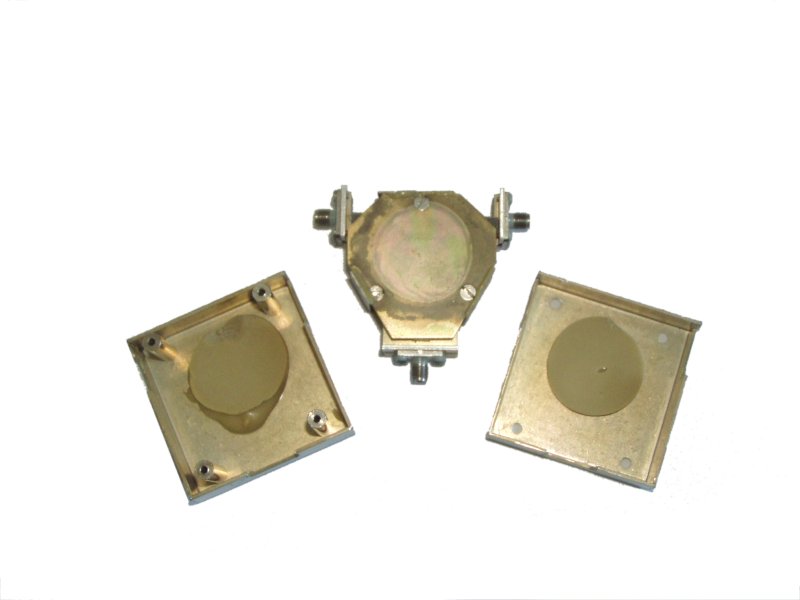
The first hard limit comes from the ferrite itself. Saturation magnetization, linewidth, dielectric constant, magnetic losses, and temperature behavior all influence how broad the usable operating range can become. A ferrite circulator does not function like a conventional reciprocal passive structure. Its directional power flow depends on gyromagnetic behavior under a DC magnetic bias, and that behavior is inherently frequency dependent.
If the ferrite material is poorly matched to the intended band, the circulator may still pass energy, but not with the balance required for low insertion loss and high isolation over a broad span. This is one reason wideband operation becomes more challenging as designers move into high frequencies, very low frequencies, or compact packages. The material must support the required nonreciprocal effect without excessive loss, while also remaining reasonably stable over the intended environmental range.
In practical engineering terms, ferrite material choice defines how much “optimization room” exists for the rest of the design. If the material foundation is weak, no matching network can fully rescue the bandwidth target.
2. Junction Topology Strongly Affects Achievable Bandwidth
The second major bandwidth limit comes from the junction type. Different circulator topologies do not offer the same bandwidth ceiling. In ferrite design literature and product selection guidance, above-resonance configurations are commonly described as more temperature stable and more compact, but more limited in bandwidth. Below-resonance approaches can achieve much broader bandwidth, but they usually require larger size and can become more temperature sensitive.
This is the point many generic articles skip, and it is exactly where real engineering begins. When someone asks, “How wide can an RF circulator bandwidth be?” the correct response is not one number. The first question should be, “Which junction configuration and which structure are we talking about?” Stripline, microstrip, coaxial, and waveguide solutions each come with different trade-offs in size, bandwidth, thermal behavior, and power performance.
In other words, one circulator may be excellent for a compact communication module, while another is better suited to a radar front end. Same device family, very different bandwidth behavior.
3. Matching Networks Help, but They Do Not Cancel Physics
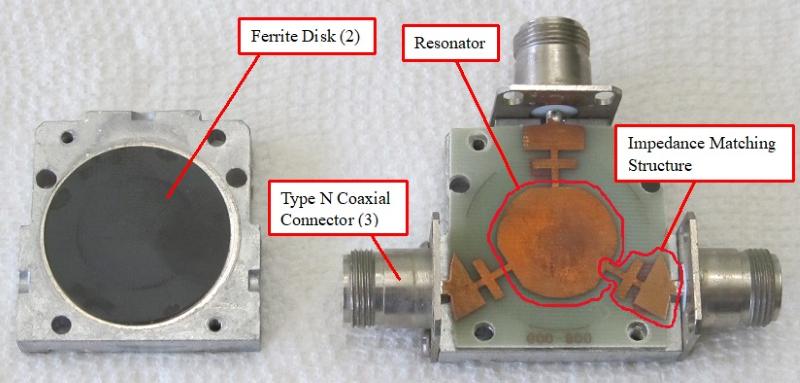
Matching networks are one of the most important engineering tools for bandwidth improvement. By controlling the impedance environment around the ferrite junction, designers can flatten the response and make insertion loss and return loss more acceptable across a wider frequency range. But matching is not magic. It can improve the behavior of the device around its intended operating region, yet it cannot erase the fundamental frequency dependence of the ferrite interaction.
This is why many wideband circulator designs are not simply “one smart ferrite disk plus one good magnet.” They often require careful matching-element tuning, resonant condition balancing, and geometry optimization. The more aggressively the bandwidth is pushed, the more the design becomes sensitive to dielectric values, assembly consistency, conductor dimensions, and bias distribution.
A wider passband on paper may therefore come at the cost of tighter manufacturing tolerances, more difficult tuning, or reduced margin at the performance edges. Broadband performance is possible, but it is never free. In RF hardware, every extra percent of bandwidth usually sends an invoice to some other parameter.
4. Magnetic Bias Uniformity Quietly Controls the Real-World Band
Designers often receive more praise for ferrite selection and less for magnetic design, but the magnet circuit matters just as much. The ferrite must experience the correct DC magnetic field, and just as importantly, the field must be distributed appropriately across the active region. If the bias field is too weak, too strong, or nonuniform, the circulation condition shifts and the band narrows.
This issue becomes more obvious in compact devices. Miniaturization is attractive for phased-array systems, dense communication modules, and portable RF platforms, but reduced volume makes magnetic-field control more difficult. The result is familiar: a part that looks sharp near center frequency, then starts to lose isolation or matching quality near the band edges.
Put bluntly, wide bandwidth requires not only the right ferrite and the right geometry, but also the right magnetic discipline. A circulator with uneven bias is like an orchestra where half the players are following yesterday’s sheet music.
5. Insertion-Loss Bandwidth and Isolation Bandwidth Are Not the Same
One of the most important buying mistakes is assuming that “bandwidth” means one clean, universal number. It does not. A circulator can show acceptable insertion loss across a certain range while its isolation performance is already degrading significantly near the edges. Likewise, return loss may remain decent for a while even as reverse isolation starts falling below what the system actually needs.
For this reason, engineers should think in terms of usable bandwidth, not headline bandwidth. The practical operating band is the region where insertion loss, isolation, and VSWR all remain inside the real specification window. That window depends on the application. In a receiver protection path, isolation matters more. In a system where total link budget is tight, insertion loss may dominate. In compact broadband assemblies, return loss at the ports can become the hidden troublemaker.
So when reviewing a data sheet, do not stop at the frequency range printed near the top. That line is the invitation, not the whole conversation.
| Bandwidth-Limiting Factor | How It Limits the Circulator | Typical Trade-Off |
|---|---|---|
| Ferrite material properties | Defines nonreciprocal response, loss behavior, and how broad the effective operating region can be | Better bandwidth may require more difficult material selection or reduced stability elsewhere |
| Junction topology | Different above-resonance, below-resonance, stripline, coaxial, and waveguide structures support different bandwidth ranges | Wider bandwidth may mean larger size or lower thermal stability |
| Matching network design | Can flatten impedance response and broaden practical operation | More complexity and tighter tolerance sensitivity |
| Magnetic bias field | Uneven or incorrect bias narrows the useful band and degrades isolation consistency | Compact packaging makes field shaping harder |
| Temperature behavior | Ferrite and magnet properties shift with temperature, compressing usable bandwidth | May require compensation materials or stricter environmental limits |
| Power handling | High-power designs often need larger, more conservative structures that are harder to make broadband | Higher power can reduce bandwidth flexibility |
| Manufacturing tolerances | Broadband designs are more sensitive to dimensional and material variation | Yield and repeatability can become harder to maintain |
6. Temperature Stability Shrinks Practical Bandwidth
A circulator measured at room temperature may appear broader-band than it really is in service. Ferrite properties and magnetic behavior vary with temperature, and those shifts move the optimum operating point. As temperature changes, the balance between loss, isolation, and matching also changes. That means the practical bandwidth over the full environmental range is often narrower than the nominal laboratory bandwidth.
This is especially important in aerospace, defense, outdoor telecom, industrial electronics, and any platform exposed to thermal cycling. A device that behaves well on a calm test bench can become far less elegant after repeated real-world temperature excursions. Some manufacturers use temperature-compensating materials in the magnetic circuit to reduce this drift, but compensation also comes with design complexity and performance balancing.
So yes, the bandwidth printed in the brochure matters. But the bandwidth that survives summer heat, winter cold, enclosure gradients, and power-induced warming is the one that pays the bills.
7. Power Handling and Bandwidth Often Pull in Opposite Directions
High power handling is another major reason RF circulator bandwidth cannot be stretched indefinitely. High-power devices usually require more robust structures, stronger thermal paths, controlled field intensity, and conservative geometry choices. Those measures help prevent overheating, arcing, or ferrite stress, but they can make broadband optimization more difficult.
This is why high-power waveguide circulators, for example, are often associated with excellent power capability but relatively constrained bandwidth compared with more bandwidth-oriented low-power designs. In many real systems, especially radar and test equipment, engineers do not ask for bandwidth in isolation. They ask for bandwidth together with low insertion loss, high isolation, high power, compact size, and environmental ruggedness.
That combination is not impossible, but it is where circulator design stops being a catalog exercise and becomes an engineering negotiation. The laws of electromagnetics are polite enough to let you choose your compromise, but never kind enough to let you skip it.
8. Size, Frequency, and Manufacturing Tolerances Shape the Final Result
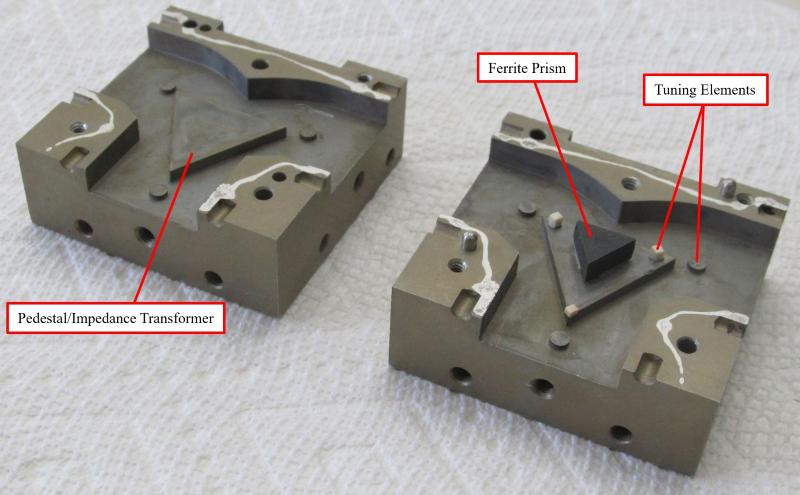
Lower-frequency circulators and wider-band circulators are often physically larger, because the magnetic circuit, junction dimensions, and matching structures all need space. A package that is too small for the intended bandwidth goal can force painful compromises in field uniformity, matching effectiveness, or repeatable assembly. This is one reason why compactness and bandwidth often fight like siblings at a family dinner.
Manufacturing tolerances also become more punishing in broadband designs. Small changes in ferrite thickness, dielectric placement, conductor dimensions, adhesive layers, or magnet alignment may not destroy a narrowband part, but they can shift a wideband device enough to reduce edge performance or lower yield. Engineers therefore do not judge bandwidth only by simulation curves. They also judge it by how consistently the part can be produced in volume.
This matters to buyers as much as to design teams. A bandwidth number is useful, but repeatable bandwidth across lots is what determines whether a circulator really belongs in a stable supply chain.
Conclusion
So, what limits the bandwidth of RF circulators? The honest answer is that bandwidth is constrained by a stack of interacting realities: ferrite material properties, resonance mode, junction topology, matching strategy, magnetic bias uniformity, package size, temperature behavior, power handling, and production tolerance. No single design trick removes all of these constraints at once.
For engineers and sourcing teams, this means the right question is not simply “How wide is the bandwidth?” The better question is “How wide is the bandwidth while still meeting insertion loss, isolation, VSWR, temperature, size, and power requirements at the same time?” That is the question that separates a lab-friendly component from a system-ready one.
In the end, RF circulator bandwidth is not limited by laziness or lack of tuning effort. It is limited by physics, then translated into product reality by engineering trade-offs. Which, frankly, is a much more interesting story than a single line on a spec sheet.
FAQ
1. Can an RF circulator be truly ultra-wideband?
Some circulator topologies can achieve very broad operating bandwidth, especially below-resonance approaches, but the real question is whether isolation, insertion loss, and return loss all remain acceptable across that entire range. Broad transmission alone does not guarantee broad useful performance.
2. Why do some circulators have narrow bandwidth even when the frequency is low?
At lower frequencies, designers often face stronger size constraints, different ferrite behavior, and in some cases lumped-element approaches with limited fractional bandwidth. Lower frequency does not automatically mean easier wideband design.
3. Is wider bandwidth always associated with higher insertion loss?
Not always, but bandwidth expansion often involves matching and structural compromises that can increase loss or reduce isolation margin. Whether that happens depends on the design method and application target.
4. Why is edge-of-band performance so important?
Because many real failures show up there first. Insertion loss, isolation, and return loss commonly degrade near the band edges, and that is where a circulator stops behaving like the clean component promised by the center-frequency data point.
5. What should buyers ask when evaluating RF circulator bandwidth?
Buyers should ask how bandwidth is defined, what the insertion loss and isolation curves look like across the band, whether the data includes temperature range effects, what power level the part is rated for, and how consistent the performance is across production lots.
References
- Mercury Systems, Ferrite Series: Isolators and Circulators.
- Teledyne Defense Electronics, Isolators & Circulators Product Selection Guide.
- M2 Global, Basic Facts About Circulators & Isolators.
- M2 Global, How to Specify Isolators & Circulators.
- RF-CI, Knowledge Base KB-001 Operating Principle.
- COMSOL, Three-Port Ferrite Circulator and related RF simulation notes.
- Wikimedia Commons image files for ferrite and waveguide circulator structure illustrations.
Recommended Products
 Article Tags
Keith Wong
Marketing Director, Chengdu Hertz Electronic Technology Co., Ltd. (Hzbeat)
Keith has over 18 years in the RF components industry, focusing on the intersection of technology, healthcare applications, and global market trends.