What Are the Key RF Circulator Requirements for LEO Satellite Payloads?
Explore key RF circulator requirements for LEO satellite payloads, including low insertion loss, high isolation, thermal stability, power handling, compact size, and space reliability.
 Updated on: Jan 01, 1970
 Author:
Explore how low insertion loss, high isolation, thermal stability, power handling, compact size, and environmental reliability shape RF circulator selection for LEO satellite payloads.
Low Earth orbit (LEO) satellite systems are expanding the capabilities of broadband communications, Earth observation, navigation, remote sensing, and space-based internet services. Compared with traditional geostationary satellites, LEO constellations often require higher production volumes, lower payload weight, compact RF architectures, and reliable operation under frequent orbital temperature changes.
These characteristics place demanding requirements on every component in the RF front end. Although relatively small, the RF circulator plays an important role in directing microwave signals, improving isolation, and protecting sensitive transmit and receive circuits from reflected power.

The Role of an RF Circulator in a LEO Satellite Payload
An RF circulator is a non-reciprocal ferrite component that routes RF energy sequentially between its ports. In a typical three-port circulator, a signal entering Port 1 is directed to Port 2, while energy reflected from Port 2 is routed to Port 3 instead of returning to Port 1.
Within a satellite payload, circulators may be used to:
- Separate transmit and receive signal paths
- Protect power amplifiers from reflected energy
- Improve isolation between RF channels
- Route signals within communication or radar subsystems
- Support antenna-sharing architectures
- Reduce interference between sensitive payload modules
In many systems, terminating one port of a circulator converts it into an RF isolator. The resulting device allows signals to pass in one direction while absorbing reflected power at the terminated port. Because a malfunction can affect an entire RF channel, circulator selection must consider much more than nominal frequency coverage.

1. Low Insertion Loss
Low insertion loss is one of the most important RF circulator requirements for LEO satellite payloads. Every fraction of a decibel lost in the RF transmission path reduces available signal power and generates additional heat.
On the transmit side, excessive loss can lower effective radiated power. On the receive side, loss ahead of a low-noise amplifier may degrade the system noise figure and reduce receiver sensitivity.
A low-loss circulator helps:
- Preserve the satellite link budget
- Improve transmitter efficiency
- Reduce unnecessary thermal dissipation
- Maintain receiver sensitivity
- Lower the required output power of the amplifier
Insertion loss should be evaluated across the complete operating frequency and temperature ranges—not only under room-temperature laboratory conditions.
2. High Isolation
Isolation indicates how effectively a circulator prevents RF energy from reaching an undesired port. High isolation is essential for protecting sensitive components and minimizing interaction between transmit and receive channels.
Insufficient isolation may allow reflected or leaked power to enter a power amplifier, low-noise amplifier, frequency converter, or another RF module. This can cause instability, degraded performance, interference, or component damage.
For LEO satellite applications, engineers should evaluate isolation under nominal and worst-case frequencies, temperature extremes, expected power levels, antenna mismatch conditions, and manufacturing tolerances.
3. Wide Bandwidth and Frequency Stability
Modern LEO payloads increasingly use wideband channels, electronically steered antennas, flexible digital payloads, and high-throughput communication links. These systems may operate in L-, S-, C-, X-, Ku-, Ka-, or higher-frequency bands.
The selected RF circulator must maintain insertion loss, isolation, return loss, and phase performance across the required bandwidth. Frequency stability is also important because ferrite properties and magnetic bias conditions can change with temperature.
A circulator designed for terrestrial use may not automatically maintain the same operating band under orbital thermal conditions. It should therefore be optimized and tested for both bandwidth and temperature-dependent frequency shift.
4. Compact Size and Low Mass
Launch costs, payload density, and antenna architecture make size and weight critical considerations for LEO satellites. This is especially important for large constellations, where a small mass reduction in each RF channel can produce a meaningful system-level benefit.
Compact microstrip, drop-in, and surface-mount circulators can help engineers build smaller RF modules and phased-array systems. However, miniaturization must not result in unacceptable insertion loss, isolation, thermal performance, or power capacity.
The best solution is not necessarily the smallest available circulator. It is the smallest design that reliably meets all electrical, mechanical, and environmental requirements.
5. Reliable Forward and Reflected Power Handling
A satellite RF circulator must safely handle the specified forward and reflected power levels. Engineers must consider energy that may return from the antenna or downstream network during an impedance mismatch.
Mismatch conditions can result from antenna detuning, temperature-related impedance changes, deployment anomalies, component degradation, operating transitions, or unexpected load conditions.
High reflected power can create localized heating inside the ferrite junction or termination. Peak power, average power, duty cycle, VSWR, and the thermal path should therefore all be included in the circulator specification. For pulsed payloads, peak power capability can be just as important as average power handling.
6. Thermal Stability in Vacuum
A LEO satellite repeatedly moves between sunlight and shadow, producing recurring thermal changes. At the same time, heat cannot be removed through air convection in a vacuum; thermal energy must instead be transferred through conduction and radiation.
These conditions can affect ferrite material characteristics, permanent magnet performance, resonant frequency, insertion loss, isolation, mechanical interfaces, termination temperature, and long-term operating stability.
The circulator needs a suitable conductive thermal path to the RF module or satellite structure. Its mounting surface, housing, interface materials, and fastener design can influence the actual temperature of the ferrite junction. Thermal analysis should therefore treat the circulator as part of the complete payload assembly.
7. Resistance to Launch Vibration and Mechanical Shock
Before entering orbit, the RF circulator must survive launch. The mechanical environment may include random vibration, sinusoidal vibration, acoustic loading, and shock events.
A suitable component requires a mechanically robust structure capable of maintaining stable ferrite alignment, reliable magnetic bias, secure internal connections, consistent grounding, stable port interfaces, and housing integrity.
Mechanical deformation or internal movement can shift the frequency response or degrade isolation. Qualification should therefore verify RF performance before and after the applicable vibration and shock tests.
8. Vacuum-Compatible Materials and Construction
Materials used in satellite payload hardware should be evaluated for vacuum compatibility. Adhesives, coatings, cable materials, and other organic substances may release volatile compounds in a vacuum.
Outgassing can contaminate nearby optical surfaces, thermal-control materials, or sensitive payload hardware. Material selection, cleaning, plating, bonding, and assembly processes must therefore match the space program's requirements.
Hermeticity may also be required in some applications, although the appropriate packaging approach depends on the mission, orbit, design life, and system-level enclosure.

9. Low Passive Intermodulation
Passive intermodulation (PIM) is a major concern in high-power, multicarrier satellite communication systems. Nonlinear metal contacts, contaminated surfaces, unsuitable plating, loose joints, and ferromagnetic materials can generate unwanted intermodulation products.
These products may fall within a receive band and interfere with weak incoming signals. Low-PIM circulator design requires careful control of contact pressure, surface finish, plating, material combinations, soldering, connector interfaces, and cleanliness.
PIM performance should be evaluated at the assembly level because connectors, cables, transitions, and mounting interfaces can also contribute to intermodulation.
10. Space-Environment Assessment and Long-Term Reliability
RF circulators are passive components, but their materials and interfaces must still be assessed for the intended space environment. Radiation exposure, atomic oxygen in some LEO conditions, thermal cycling, and long-term vacuum operation should be considered according to the mission profile.
Component evaluation may include:
- Material screening
- Thermal cycling and thermal-vacuum testing
- Vibration and shock testing
- Radiation assessment
- Burn-in or screening procedures
- Lot traceability
- RF performance verification
Not every LEO mission requires the same qualification level. A short-duration technology demonstration and a long-life commercial constellation may have very different reliability and documentation requirements.
How to Specify an RF Circulator for a LEO Satellite
Engineers should provide more than a center frequency and power rating. A complete RF circulator specification should include:
- Operating frequency range
- Maximum insertion loss
- Minimum isolation
- Maximum input and output VSWR
- Forward and reflected power
- Peak and average power
- Operating temperature range
- Mechanical dimensions and mass
- Port and mounting configuration
- Thermal interface conditions
- Vibration and shock requirements
- Vacuum and outgassing requirements
- PIM limits, if applicable
- Screening, testing, traceability, and documentation requirements
Providing this information early allows the manufacturer to optimize the ferrite material, magnetic circuit, transmission structure, housing, termination, and thermal design for the actual payload environment.
Which Circulator Type Is Suitable for a LEO Payload?
The appropriate construction depends on frequency, power, available space, integration method, and environmental requirements.
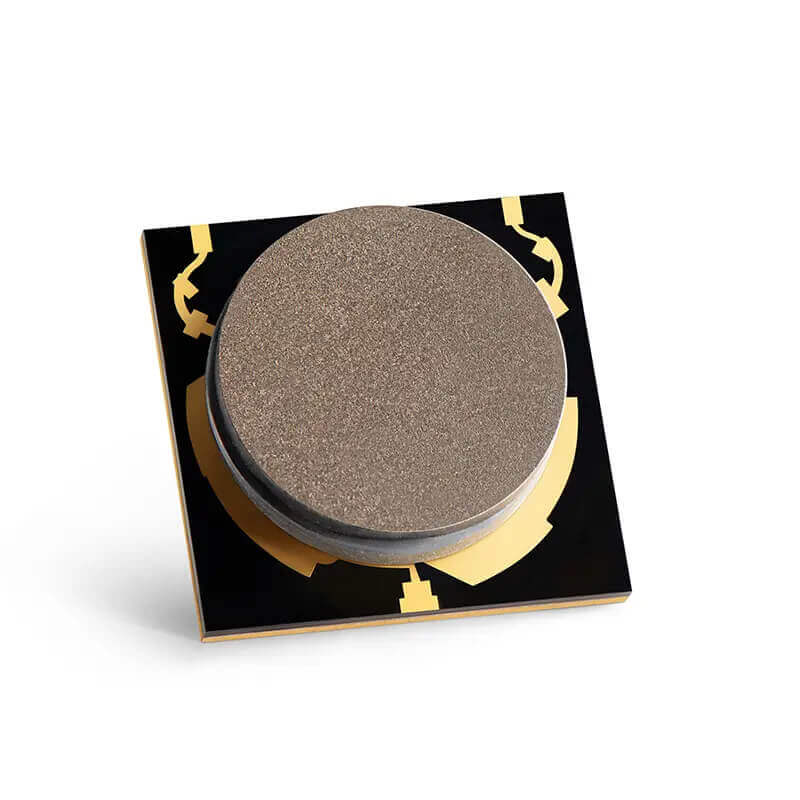
Microstrip Circulators
Microstrip circulators are well suited to compact RF modules and phased-array architectures where a low profile and reduced weight are important.
Drop-In Circulators
Drop-in circulators offer convenient integration into amplifier modules and other embedded microwave assemblies.
Coaxial Circulators
Coaxial circulators provide connectorized interfaces, mechanical robustness, and flexible test or subsystem integration.
Waveguide Circulators
Waveguide circulators may be considered for high-frequency or high-power satellite links where low transmission loss and strong power-handling capability are required.
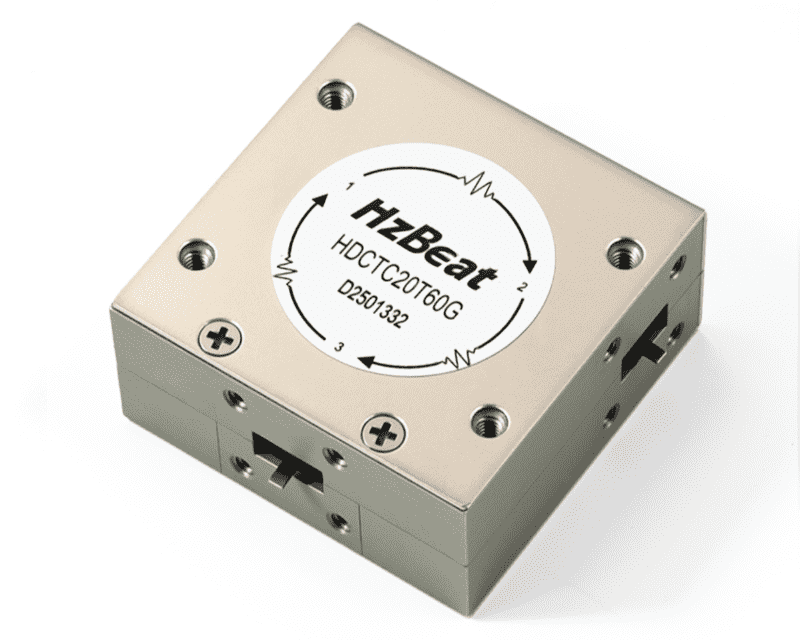
HzBeat develops microstrip, drop-in, coaxial, waveguide, and dual-junction RF circulator solutions across a wide frequency range. Explore the HzBeat RF circulator portfolio for more product information.
Conclusion
LEO satellite payloads place demanding requirements on RF circulators. Low insertion loss and high isolation remain fundamental, but successful space integration also depends on bandwidth, temperature stability, reflected-power capability, mechanical strength, vacuum-compatible construction, PIM control, and long-term reliability.
Most importantly, an RF circulator should be selected according to the complete mission environment—not simply its room-temperature datasheet values.
For applications that cannot be supported by a standard component, a customized design may provide a better balance of electrical performance, size, weight, thermal behavior, and mechanical integration.
FAQ
Can a standard commercial RF circulator be used in a LEO satellite?
Possibly, but catalog performance alone is not enough to make that decision. The component and its materials, interfaces, mounting method, thermal path, screening, and verification plan should be assessed against the mission requirements.
Which circulator parameter has the greatest effect on a satellite link budget?
Insertion loss has a direct effect on available transmit power and can affect receive sensitivity when the component is placed ahead of a low-noise stage. Isolation, return loss, and mismatch behavior remain essential to overall RF stability and protection.
Why is reflected-power capability important in a LEO payload?
Antenna detuning, deployment conditions, temperature variation, and downstream mismatch can return energy toward the transmitter. The circulator must route and tolerate the specified reflected power without excessive heating or degraded performance.
Are microstrip circulators suitable for compact LEO payloads?
Microstrip circulators can be attractive where low profile, low mass, and close integration are priorities. Suitability still depends on frequency, bandwidth, loss, isolation, power, thermal design, assembly method, and the required environmental verification.
What information should be sent to a circulator manufacturer?
Provide the frequency range, insertion loss, isolation, VSWR, forward and reflected power, temperature range, package limits, interface requirements, thermal conditions, environmental tests, PIM target, and documentation or traceability needs.
Recommended Products
.jpg)
 Article Tags
Keith Wong
Marketing Director, Chengdu Hertz Electronic Technology Co., Ltd. (Hzbeat)
Keith has over 18 years in the RF components industry, focusing on the intersection of technology, healthcare applications, and global market trends.